
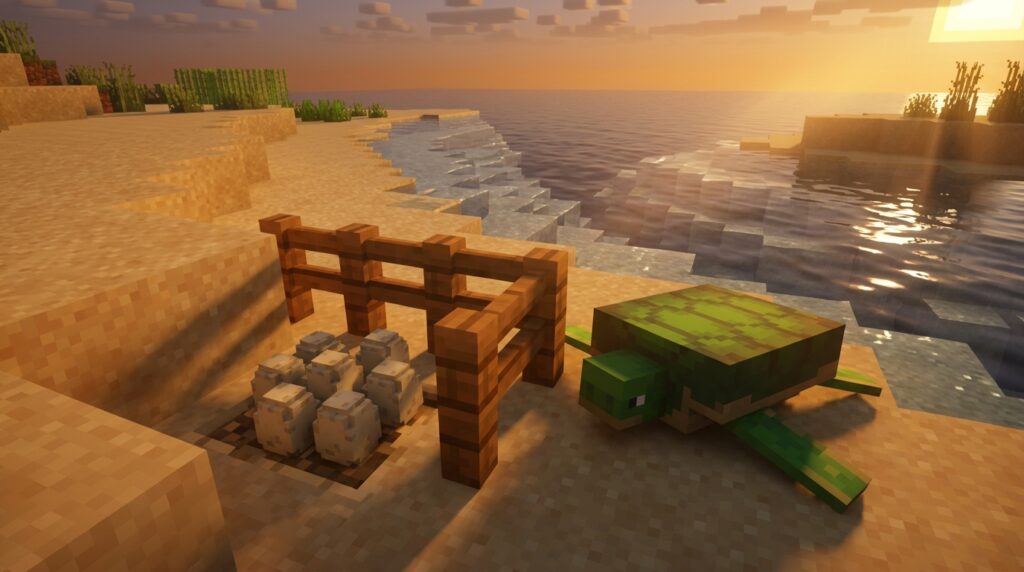
Minecraft turtle eggs appear after you feed two turtles seagrass. The turtle that lays the eggs returns to its home beach, even if you bred the turtles somewhere else. Each egg block can contain one to four eggs. Eggs need sand or red sand beneath them and time to pass through three cracking stages, often over several in-game nights. You can leave them at the home beach or move them with a Silk Touch-enchanted tool.
Protect the eggs from zombies, husks, and drowned, which can seek them out and trample them. Fence off the nest, and avoid stepping on it while you work nearby. Keep watch on the hatchlings after they emerge, because baby turtles are vulnerable too. Each turtle drops a turtle scute when it matures. You can use scutes to craft a turtle shell. A sheltered sandy area, careful handling, and patience can turn a beach nest into a source of scutes.
Key Takeaways
- You can get turtle eggs by feeding two turtles seagrass, but the egg-laying turtle returns to its home beach, so prepare that beach before breeding.
- Turtle eggs need sand or red sand directly beneath them, and you must use a Silk Touch-enchanted tool to move egg blocks without breaking them.
- Turtle eggs hatch after reaching three cracking stages, often over several in-game nights; about 90% hatch within seven nights, and cracking is guaranteed on a random tick from 3:36 a.m. to 4:33 a.m.
- You can protect turtle eggs and hatchlings with a closed fence or wall, since zombies, husks, drowned, and other threats can trample the nest; each turtle drops one scute when it matures.
How Do You Get Turtle Eggs?
Feed two turtles seagrass to make them breed. The turtle that lays the eggs returns to its home beach to lay them. If you want the nest in a particular spot, prepare that beach before you encourage the turtles to breed.
Search sandy beaches near the water for turtles. They may wander away from the beach where they spawned, so breeding them wherever you find them does not guarantee that eggs will appear there. Watch the egg-laying turtle after breeding and follow it back to its home beach.
The home beach matters because the turtle returns there to lay eggs, even if you fed it somewhere else. Before breeding, clear a flat patch of sand on that beach and make room for the turtle to reach it. Eggs need a suitable sandy block beneath them, so keep the nesting area free of grass and other blocks.
Prepare the spot as a small enclosure before bringing the turtles together. Build walls or a fence around the sandy patch, add a gate for access, and light the surrounding area to limit hostile mob spawns nearby. Leave enough open sand inside for the turtle to lay eggs. With the enclosure ready, you can watch the nest safely without building around the eggs afterward.
How Can You Collect Turtle Eggs?
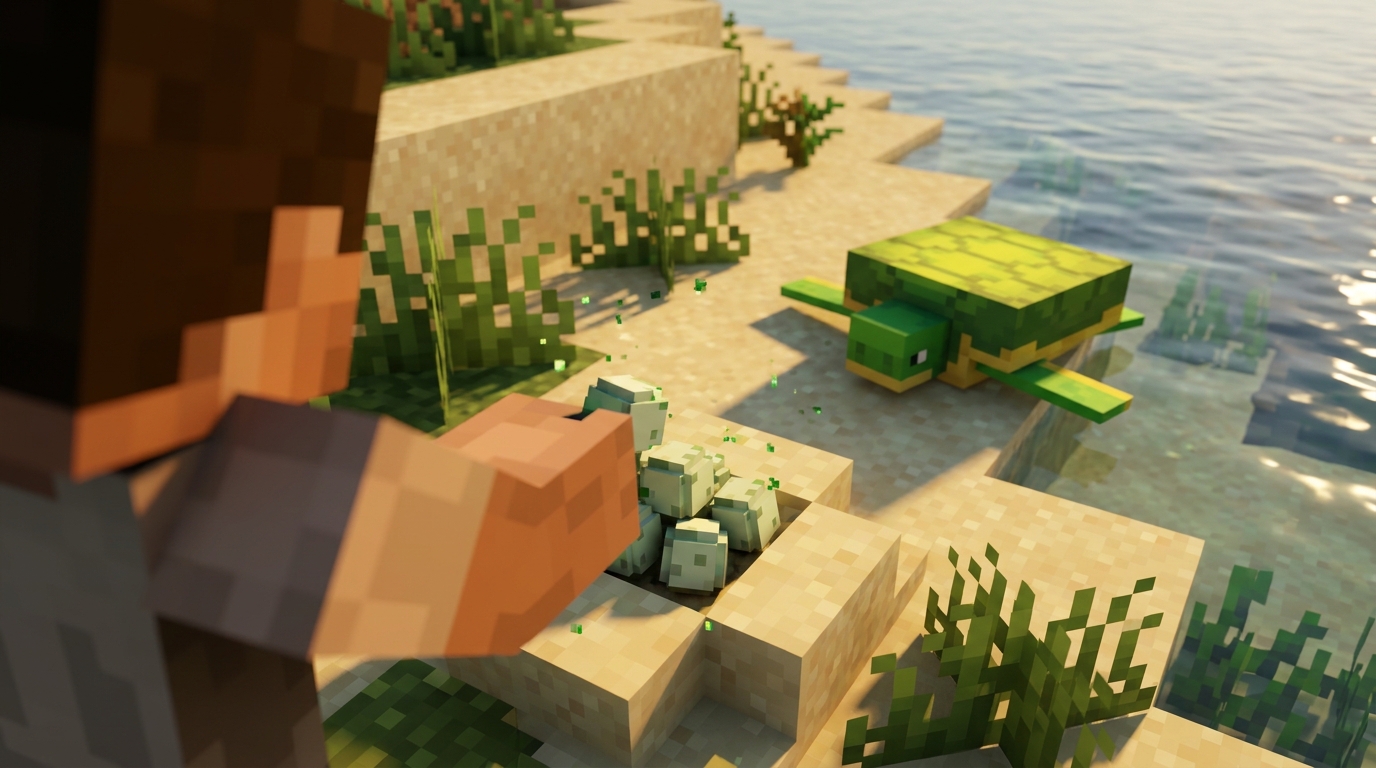
You can collect turtle eggs by mining each egg block with a Silk Touch-enchanted tool, or leave the nest where it is and protect it. A turtle egg block can contain one to four eggs, so decide whether the home beach is safe and easy to reach before moving the nest. Follow these steps to choose an option and handle the eggs without breaking them:
- Choose whether to move the nest. Leave the eggs at the home beach if you can keep the area safe. Relocate them if the spot is exposed or difficult to guard.
- Check the egg blocks. Each block may hold one to four eggs, so note which blocks you need to collect.
- Use a Silk Touch-enchanted tool. The enchantment is required for an egg block to drop as an item when mined.
- Mine each egg block carefully. Breaking an egg without Silk Touch destroys it and drops no item, so do not use an unenchanted tool or your hand.
- Place the collected eggs in a safer sandy area. Choose sand or red sand inside a protected space, such as an enclosure near your base, where you can keep watch.
If the home beach already has a sheltered place for the nest, leaving the eggs there saves you from moving them. If you cannot protect that beach, careful Silk Touch mining lets you move the egg blocks instead of losing them.
How Do Turtle Eggs Hatch?
Turtle eggs hatch on sand or red sand after progressing through three cracking stages. Each stage shows deeper cracks in the egg block, so you can tell that hatching is underway. Eggs need time on a suitable sandy block, and a slow start does not necessarily mean they are broken. Hatching usually takes several in-game nights because cracks appear as the game updates the eggs, rather than all at once. About 90% of eggs hatch within seven nights or less, but some may take longer. During a daytime random tick, an egg has only a 1-in-500 chance of cracking, so you may see little or no progress during the day. Progress is especially likely late at night. From 3:36 a.m. to 4:33 a.m. in-game, eggs are guaranteed to crack on a random tick. This concentrated window helps explain why you may notice a new crack in the morning, even if the eggs seemed unchanged earlier. If you are watching a nest, check the eggs after the late-night window and look for changes between the three cracking stages. Make sure sand or red sand remains beneath the egg block. A nest on another block will not hatch. Give the eggs several nights before deciding something is wrong, since slow progress can be normal.
How Can You Protect Turtle Eggs?
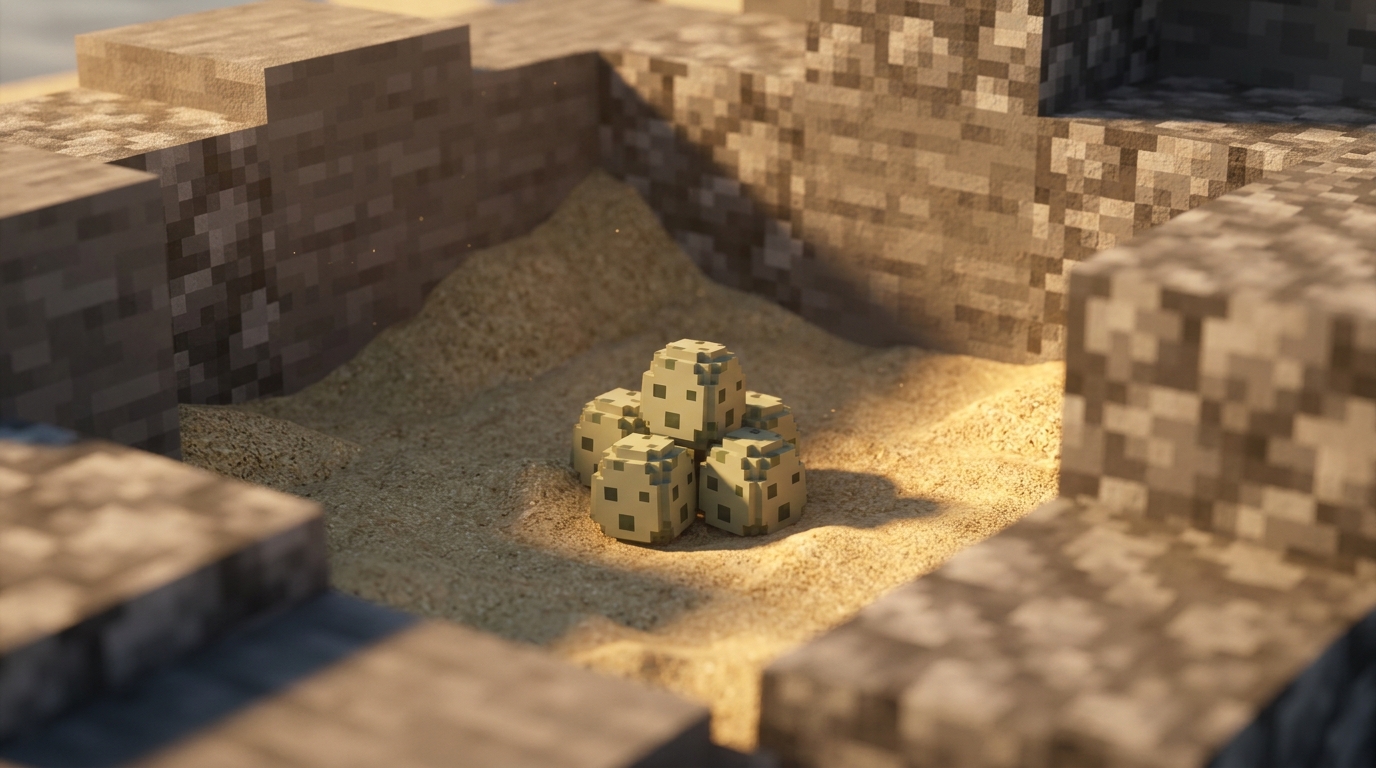
Protect turtle eggs and hatchlings with a secure barrier, keep hostile mobs away, and avoid stepping or falling onto the nest. Zombies, husks, drowned, zombie villagers, and zombified piglins seek out and trample eggs when there are two air blocks above them, unless mobGriefing is false. Foxes and stray cats can also threaten eggs or baby turtles. Follow these steps to protect the nest from the time you place the eggs until the hatchlings are safe:
- Close off the nesting area. Use a continuous wall or fence and keep its gate shut so mobs cannot wander onto the eggs. Check for gaps along the ground where a mob could enter.
- Check the area for hostile mobs. Patrol the enclosure and nearby beach, especially for zombies and their variants. Deal with any you find before leaving the nest unattended. A barrier also helps keep foxes and stray cats away.
- Keep entities off the eggs. Walk around the nest instead of across it, and avoid jumping or dropping onto the egg block. An entity falling onto an egg has a one-in-three chance to trample it. An entity standing on an egg has a one-in-100 chance per game tick.
- Keep the barrier in place after the eggs crack. Baby turtles are still vulnerable to predators, including foxes and stray cats. Check the enclosure after hatching and keep the hatchlings protected. Cracked eggs do not mean the danger is over.
Why Are Turtle Eggs Not Hatching?
Turtle eggs may not be hatching because the block beneath them is unsuitable, not enough in-game nights have passed, or mobs have disturbed the nest. Check the setup before moving or replacing the eggs.
- Check the block underneath. Each egg block needs sand or red sand directly below it. If an egg is resting on grass, dirt, or another block, move it onto a sandy spot with Silk Touch.
- Look for cracks. Turtle eggs show hatching progress through three cracking stages. A change in the cracks means the eggs are advancing toward hatching.
- Give the eggs time. Hatching is not immediate and can take several in-game nights. Progress is especially likely late at night, so a few daytime checks without a visible change do not tell you much.
- Check for disturbance. Look for zombies, husks, drowned, zombie villagers, or zombified piglins that can reach the eggs. Check for gaps in the enclosure, and make sure mobs, players, and other entities cannot step on the eggs.
If the eggs still look unchanged, check the sandy block and the barrier rather than assuming the nest is broken. Turtle eggs do not crack at a steady, easy-to-spot pace, so a lack of visible progress does not by itself mean the eggs are permanently stuck. If you find a mob inside the enclosure, remove the threat and close the gap. Then give the eggs more in-game nights to develop.
From Turtle Eggs To Scutes
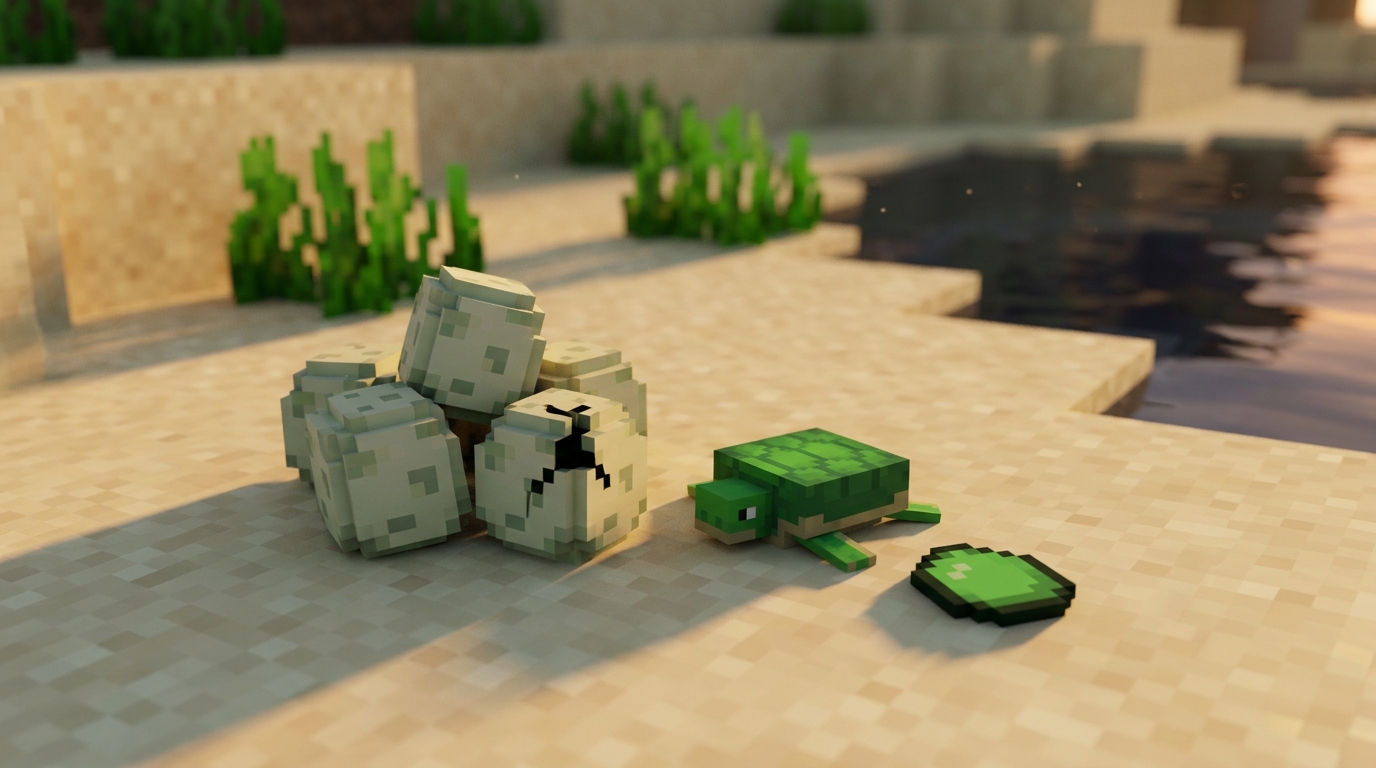
After hatching, keep each baby turtle in a protected area until it matures. Each baby turtle drops a scute when it grows up, so keeping the hatchlings safe is how you build a supply.
Pick up the dropped scutes and store them with your crafting materials. Turtle eggs are not used to craft a turtle shell. The scute comes from the turtle when it matures.
Keep checking the hatchlings instead of leaving as soon as the eggs hatch. A baby turtle that does not survive to maturity cannot provide a scute. Once the turtles mature, use the scutes to craft a turtle shell.
Start With A Protected Home Beach
Choose a home beach you can visit often and make it your turtle nursery before breeding. Mark a clear route from your base to the beach, then build a closed fence or wall around the nesting area with a gate you can shut behind you. Put the gate on the side facing your route so you can check the nest without walking across the sand.
If you already have eggs on an exposed beach, secure the nest first. Close gaps at ground level and check the enclosure after you enter or leave. An open gate can undo the barrier while you are away. Keep the sandy patch inside the enclosure clear, and leave enough room to reach the eggs without stepping on them.
If you control the world’s game rules, you can set mobGriefing to false to stop zombies and their variants from trampling eggs. That setting applies beyond one beach, so use it only if you want that rule for the world. Mojang’s Java Edition 1.13 Update Aquatic notes also advise protecting eggs from hostile mobs. Start with the barrier if you want to keep the rest of your world rules unchanged.