
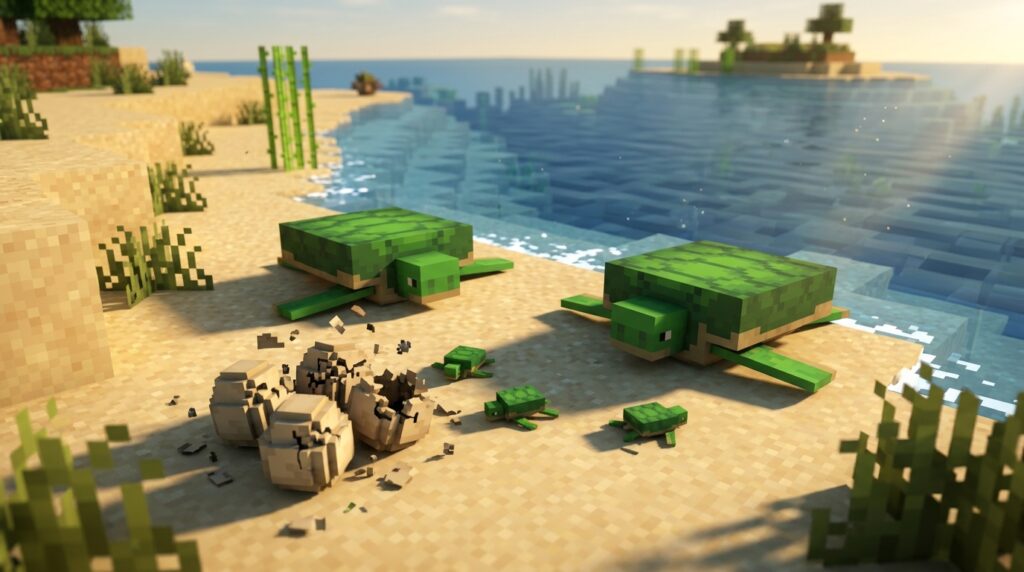
Turtle eggs usually take about four to five in-game days to hatch. Each egg cracks three times before a baby turtle emerges. Cracks show progress, and eggs advance faster at night, so the wait can vary. Eggs need sand or red sand beneath them and a player within 128 blocks horizontally to progress. Zombies and other entities can trample the nest, so protect it while you wait. The Minecraft Wiki’s turtle egg guide explains how hatching works.
To get a clutch, feed seagrass to two turtles to put them in love mode. A turtle lays eggs on the beach where it hatched, so the nest may appear somewhere other than your base. Clear a safe patch of sand, protect the eggs, and watch for cracks instead of breaking them to check their progress. Mojang’s guide to turtle breeding explains how the cycle begins.
Key Takeaways
- Turtle eggs usually hatch in about four to five in-game days, crack three times before hatching, progress faster at night, and need sand, red sand, or suspicious sand beneath them plus a player within 128 blocks horizontally.
- To get turtle eggs, feed seagrass to two turtles and search the beach where the laying turtle hatched, since the nest may appear far from where you bred the pair.
- Protect turtle eggs inside a fence or solid-block enclosure and keep foot traffic away, because a falling entity has a one-in-three chance to trample an egg and an entity standing on an egg has a one-in-100 chance per tick of breaking it.
- Move turtle eggs only with a Silk Touch tool, place them on a suitable sandy surface, and check each egg separately because eggs in one clutch crack and hatch at different times.
- Each baby turtle takes one in-game day to become an adult, so keep the nest protected while unhatched eggs finish hatching and the babies grow.
How Long Do Turtle Eggs Take to Hatch?
The cracks mark stages of progress, but they do not happen at evenly spaced intervals.
Eggs progress faster at night, so a nest may look unchanged during the day even when the wait is normal. During a daytime random tick, an egg has only a one-in-500 chance to crack. An egg is guaranteed to crack if a random tick reaches it between 21,600 and 22,550 in-game ticks. As a result, visible changes may come in bursts rather than at a steady pace.
A player must be within 128 blocks horizontally for the eggs to progress. If you travel beyond that range, the eggs stop advancing until you return. You do not need to stand beside the nest, but staying within range keeps the eggs progressing.
A single turtle-egg block can hold one to four eggs, and each egg tracks its own progress. For example, one egg in a clutch may show two cracks while the egg beside it has not cracked yet. That is normal. Eggs in the same block can be at different stages, so the clutch may hatch over time rather than all at once.
Check the eggs individually instead of expecting the whole block to change together. A crack shows that an egg has progressed; an uncracked neighbor may simply be at an earlier stage. Daytime pauses between visible changes and staggered cracks within one clutch do not, by themselves, mean an egg is stuck.
How Do You Get Turtle Eggs?
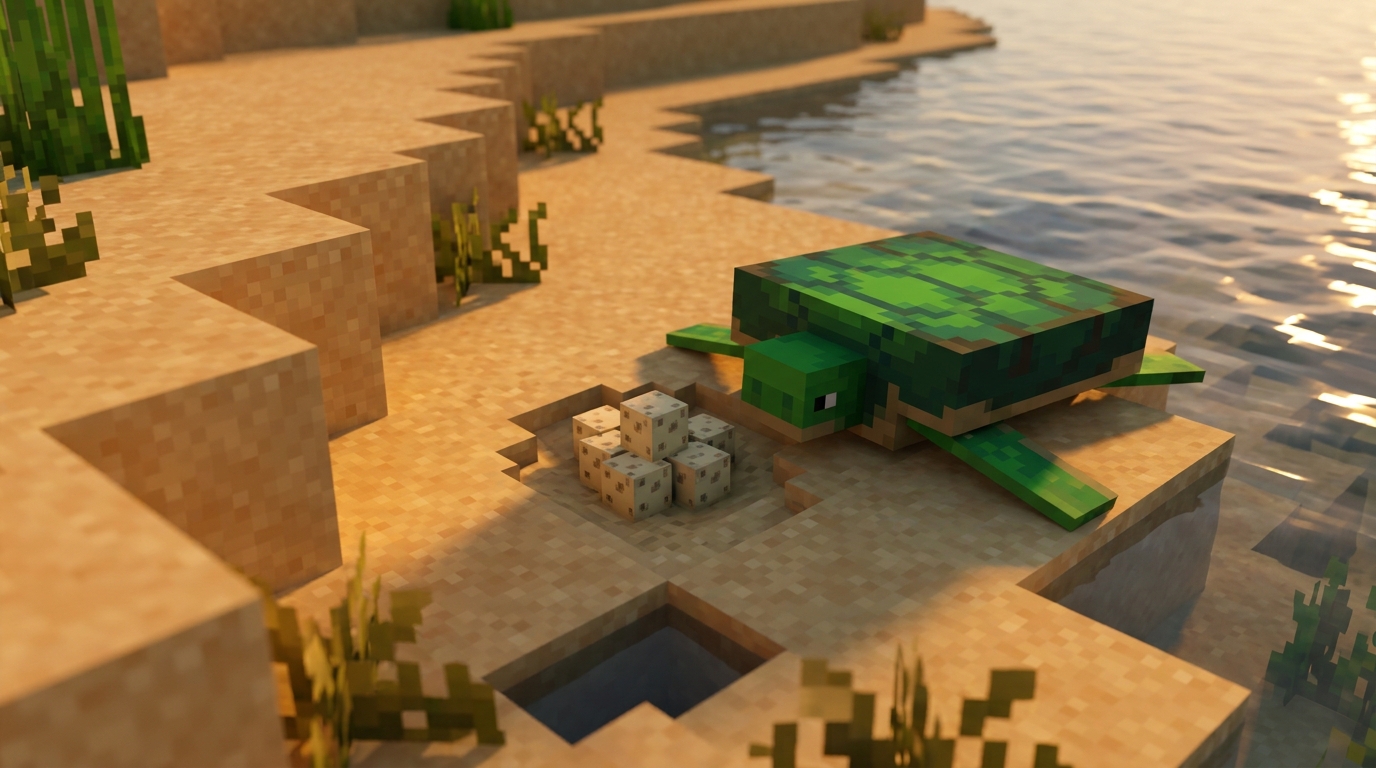
To get a clutch, feed seagrass to two turtles, then look for the nest on the beach where one of them hatched. The eggs do not appear where you breed the turtles. Instead, they appear on the laying turtle’s hatch beach.
- Find two turtles and have seagrass ready.
- Feed seagrass to each turtle. Both need to enter love mode for breeding to begin.
- Watch for one turtle to lay eggs. It lays them on the beach where it hatched, which may be far from where you fed the pair.
- Look for the turtle-egg block on that beach. Protect the nest where it appears rather than expecting the eggs to show up at your breeding spot.
- Check how many eggs the block holds. A turtle-egg block can contain one to four eggs, and each egg can hatch into a baby turtle.
The key detail is the laying turtle’s hatch beach. For example, breeding two turtles beside your base does not mean the clutch will appear on nearby sand. The eggs may be laid on the beach where the laying turtle hatched, so search there and protect the nest. A block with several eggs can produce several baby turtles, with each egg hatching individually.
Where Should You Place Turtle Eggs?
Place turtle eggs on sand, red sand, or suspicious sand, which are suitable hatching surfaces in Minecraft. If you need to move a clutch, mine each egg with a Silk Touch tool to collect it as an item. Mining an egg without Silk Touch breaks it without dropping anything. Choose a level patch of a suitable surface and place the collected eggs carefully. For example, you can make a small sandy enclosure near the nest and set the eggs inside on sand. Moving a clutch changes its location, not how hatching works. Keep the eggs away from foot traffic. Players and other entities can trample eggs by walking or falling onto them, so surround the enclosure with a fence or wall and leave a clear route around it. Avoid placing eggs on a path, beside a doorway, or anywhere you regularly walk. Suspicious sand is also a suitable hatching surface, but ordinary sand is a straightforward choice for a relocated clutch. Whatever surface you use, place the eggs gently and keep the area clear so they are not accidentally broken before they hatch.
How Can You Protect Turtle Eggs?
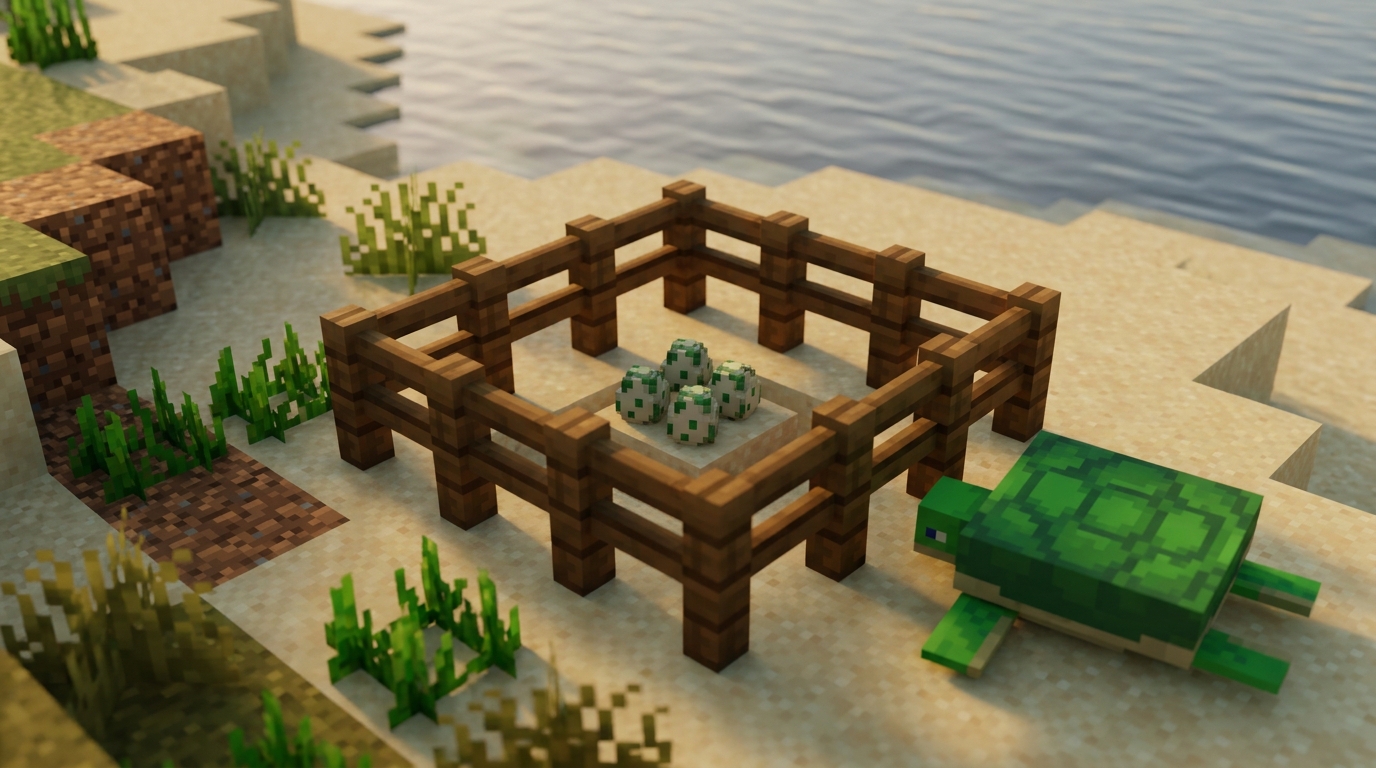
Protect turtle eggs by enclosing the nest, keeping foot traffic away, and blocking zombies and their variants from reaching the eggs. Any entity that falls onto an egg has a one-in-three chance of trampling it. An entity standing on an egg has a one-in-100 chance per tick of breaking it, so even lingering near the nest can put the clutch at risk. Zombies and their variants actively seek out turtle eggs and trample them unless the mobGriefing game rule is false. A fence or ring of solid blocks can keep these mobs away, but make sure your own route around the nest does not cross the eggs. Enclose the nest with blocks or a fence, leaving enough room to approach without stepping inside. Keep the eggs away from paths, doorways, and other places where you might walk or fall onto them. Check the enclosure for gaps where a zombie could enter and reach the eggs. Bedrock Edition players can also use sculk sensors to detect egg cracking. In Bedrock Edition 1.20.30, a turtle egg emits a vibration when it cracks, which a nearby sensor can detect. This can signal that an egg has progressed or alert you if the nest is disturbed. Read the Minecraft Feedback notes for the update for details about the vibration change.
Why Are Turtle Eggs Not Hatching?
Turtle eggs may be progressing slowly, but eggs on the wrong block, outside a player’s range, or damaged by trampling will not hatch normally. Check the nest in this order to find the cause. First, check the block directly beneath the eggs. Turtle eggs hatch on sand, red sand, or suspicious sand; another surface can prevent progress. If the eggs are on a suitable surface, make sure a player is within 128 blocks horizontally. You do not need to stand beside the nest, but the eggs stop advancing when no player is close enough. Next, look closely at each egg for cracks. Turtle eggs crack three times before hatching, and they progress faster at night. A clutch can take about four to five in-game days to hatch, so a long wait without a new crack does not necessarily mean something is wrong. Eggs in the same block may also show different amounts of cracking. If eggs disappear or break, check for trampling. Players and mobs can damage eggs by standing or falling on them. Zombies and their variants actively seek out turtle eggs, so check for gaps in the enclosure and keep the nest clear of foot traffic. Java Edition once had a bug that checked for sand one block too deep, which could stop eggs from hatching. Mojang marked the issue fixed in 1.16 Pre-release 7, so it is historical context, not a fix you need to apply now. The bug’s record is still available in Mojira’s MC-189846 entry.
What Happens After They Hatch?
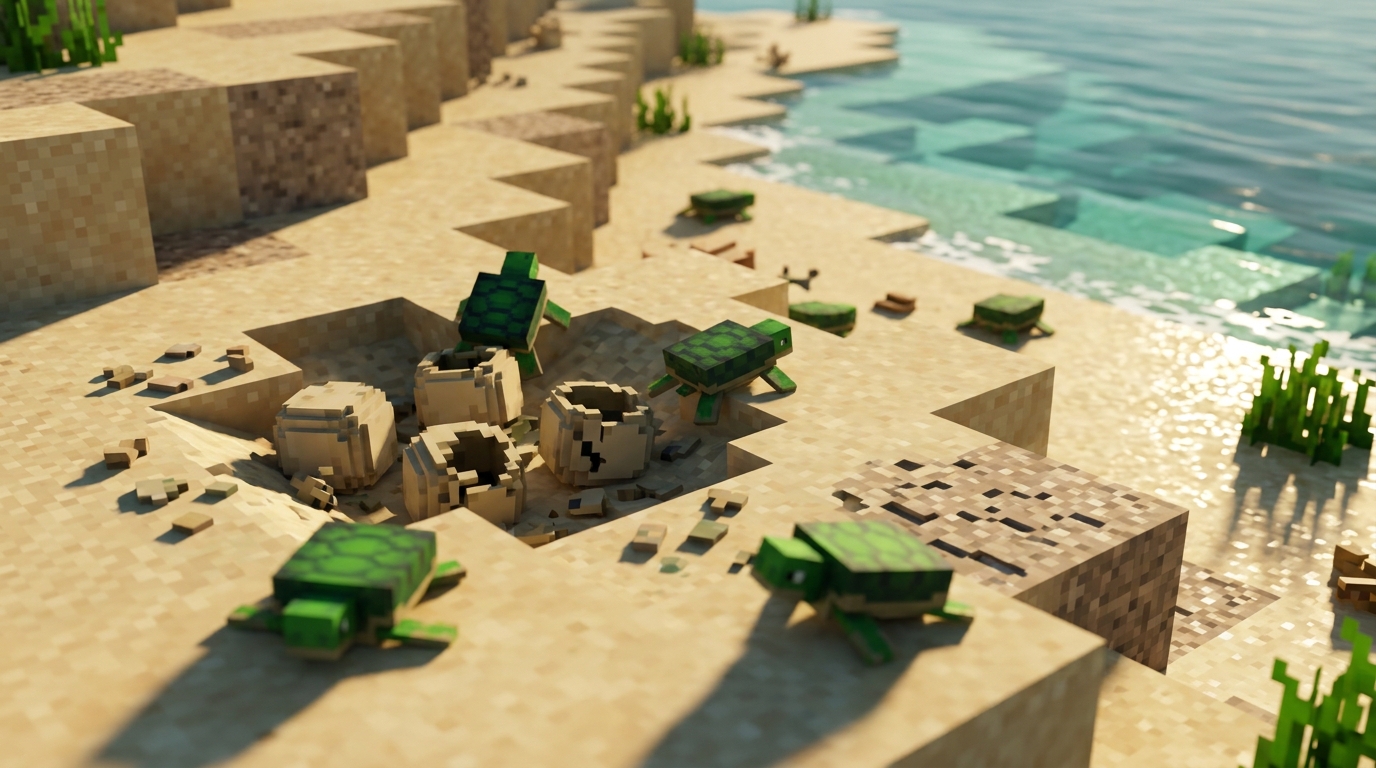
After the eggs hatch, each egg becomes a baby turtle. Each baby takes one in-game day to become an adult. A clutch can hatch in stages, so one baby may appear while other eggs are still waiting to hatch.
Keep the nest protected while the remaining eggs hatch and the babies grow. Leave the fence or block barrier in place, and avoid walking across the sandy patch. Keep zombies and other mobs away from the nest so they cannot disturb unhatched eggs.
Check each egg for cracks, keep your player within 128 blocks of the nest, and keep the sand clear of mobs and foot traffic. This gives the remaining eggs time to hatch and the baby turtles room to grow.
Keep Watch Over Your Turtle Nest
If your clutch is still intact, mark the nest on your map and stay within 128 blocks horizontally while you work nearby. Check the eggs after a Minecraft night, when cracking progress is faster, and note which ones have changed. Checking briefly is safer than standing on the sandy patch and risking the clutch.
If one egg hatches first, leave the barrier around the nest and inspect the other eggs individually. Each egg progresses on its own, so an unhatched egg beside a new baby may still be developing normally. Keep the route to the nest outside the enclosure, and do not step onto the eggs to get a closer look.
If an egg vanishes, look for a baby turtle and check the barrier for a gap. Zombies and their variants can seek out eggs, and any entity that reaches an egg can trample it. Close any opening before leaving the area.
Once every egg has hatched, keep the sandy patch clear while the babies grow. Each baby turtle needs one in-game day to become an adult. If you use a Bedrock sculk sensor, watch for its signal when an egg cracks. It can help you track progress without walking into the enclosure.