
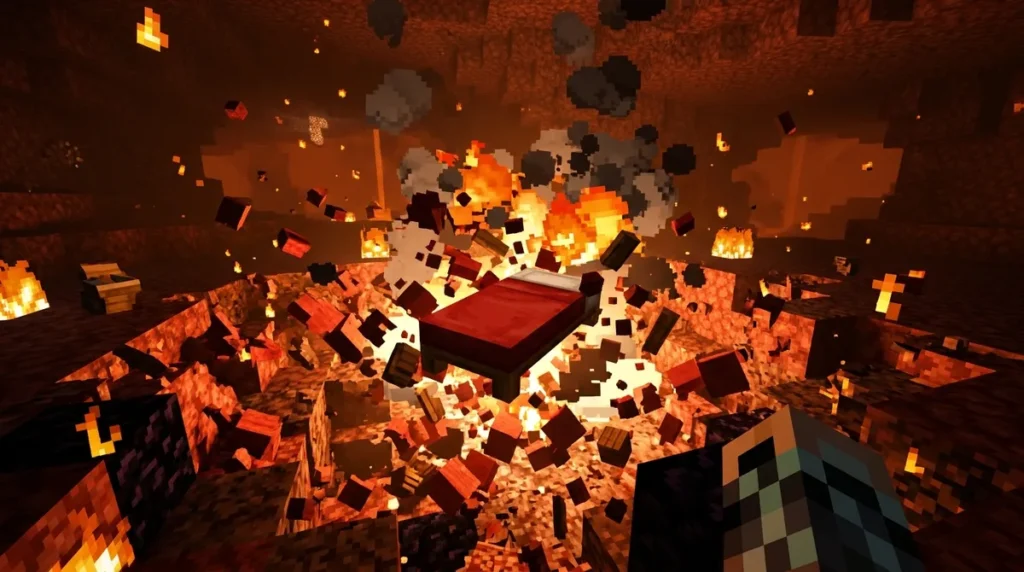
Bed explosions in Minecraft come from a power 5 blast, stronger than TNT at power 4, that can deal up to 71 health points to anything standing right at its center on Normal difficulty. The blast happens when you try to sleep in a bed in the Nether or the End, because the bed explodes instead of setting your spawn point. The blast is centered on the bed’s head, and the farther you are from it, the less damage you take. Solid blocks between you and the blast can soak up even more.
Java Edition players get this behavior by default. Bedrock Edition players can control it with the respawnBlocksExplode game rule, which is set to 1 out of the box, so the explosions stay on until you change it. Many players use these blasts to mine ancient debris in the Nether or to pressure the Ender Dragon, but both tricks depend on standing at a safe distance behind a block.
Key Takeaways
- Sleep in an Overworld bed before you travel, so your spawn point is saved somewhere safe if a Nether trip goes wrong.
- Stand 6 blocks from your bed when mining ancient debris, keeping a netherrack or obsidian block in the blast’s path.
- Your bed’s head should face the Ender Dragon’s flight path, since blasts hit hardest near the dragon’s head.
- A power 5 bed blast hits harder than TNT at power 4, though a charged creeper still reaches power 6.
Why Do Beds Explode in the Nether and End?
Beds explode in the Nether and End because the game was designed that way. In those two dimensions, trying to sleep in a bed does not set your spawn point. Instead, the bed blows up.
The rule arrived early. Minecraft Beta 1.6 Test Build 3, released on May 25, 2011, introduced the behavior in which trying to sleep in a Nether bed causes it to explode.
Many players first met the rule by accident. You might try to set a spawn point in the Nether, get a sudden blast instead, and then start wondering what else a bed could do. Once people realized the explosion could hit a monster or a wall of ore, it became a well-known trick.
The blast is not just about damage. In Java Edition, a bed explosion can also set nearby blocks on fire, and it can set you on fire too. That means a bed placed next to wooden planks, a netherrack floor, or a grass-covered area near a fire source can cause more trouble than you planned for.
How Is Bed Explosion Damage Calculated?
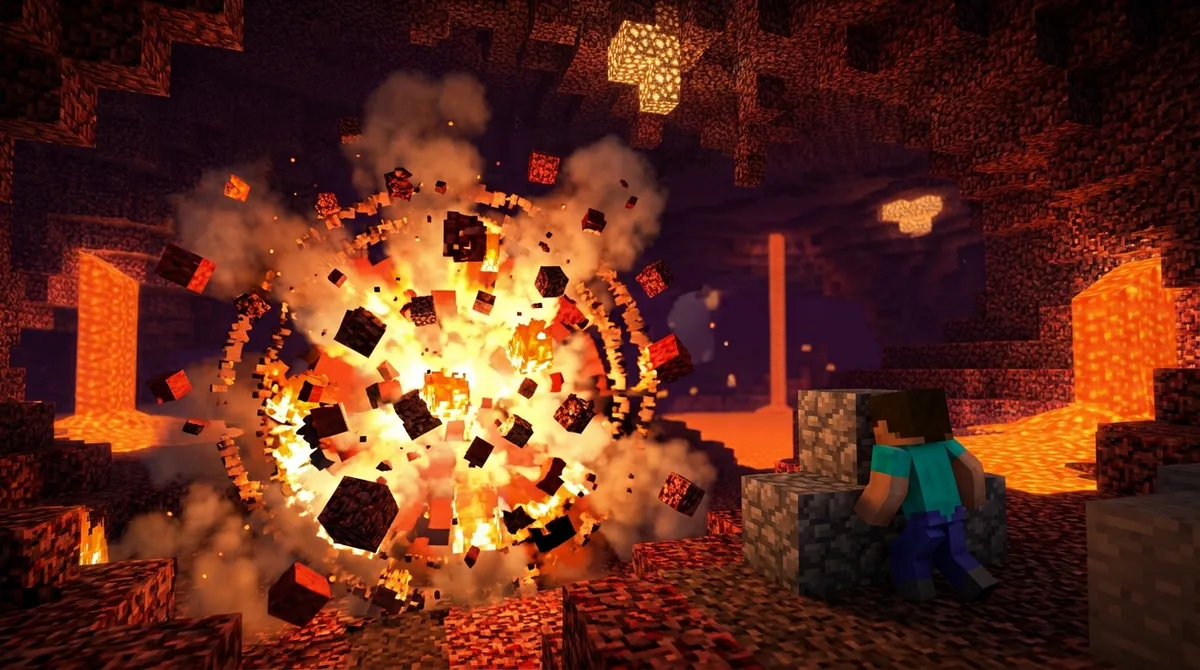
Bed explosion damage is calculated with damage = 7 × power × (impact² + impact) + 1, where impact depends on how far you are from the blast and how much of you is exposed to it. For a bed, power is 5, so the formula becomes 35 × (impact² + impact) + 1.
Impact is found with (1 − distance/(2 × power)) × exposure. For a bed, 2 × power is 10. At the center the distance part is 1, at 5 blocks away it drops to 0.5, and at 10 blocks away it reaches 0. A bigger gap or a solid block in the way pulls the result down.
Here’s how it works with real numbers. Say you stand 5 blocks from the bed with nothing between you and the blast, so exposure is full. Impact is 0.5, and the damage is 35 × (0.25 + 0.5) + 1, which comes to roughly 27 health points. Try your own numbers to see how quickly the result changes:
- Start with the power, which is 5 for a bed.
- Divide your distance in blocks by 10 to get the distance part.
- Subtract that result from 1.
- Multiply by the exposure to get impact.
- Square the impact, add the impact back, and multiply by 35.
- Add 1 at the end to get the final damage.
The blast reaches entities within 10 blocks. Anything farther away is outside the range and takes no damage from the bed. Inside that range, the formula ends with a flat +1, so an entity still takes 1 point even when a solid block fully covers it. With exposure at 0, impact is 0, and the damage is 0 + 1. That is why a mob standing behind a wall still gets hurt.
Bed Explosion Power Compared With TNT and Creepers
Power is the number that tells you how hard an explosion hits. A bed explosion has power 5, which is stronger than TNT at power 4. A charged creeper or an end crystal goes higher, at power 6. So a bed packs more punch than TNT, but it still falls short of a charged creeper or an end crystal.
Power is only part of the picture. The blast is centered on the bed’s head, not the foot, so the head is the spot that matters. If you place the bed so the head faces a wall, a stack of ore, or the path a mob will take, you decide where the heaviest blast lands. Standing at the foot end puts a block or two more distance between you and the center, which cuts the damage you take.
At the exact center, with full exposure on Normal difficulty, a power-5 bed explosion can deal up to 71 health points of damage. That number assumes nothing is blocking the blast and you are standing right on the head. Your health bar will look very different once you step back, place a block of stone between you and the bed, or play on a different difficulty.
Try this in a flat, empty Nether area before you rely on it. Place a bed, stand at different distances, and watch how your health changes. You’ll quickly see why the head position and your spacing matter more than any single number.
Using Bed Explosions to Mine Ancient Debris
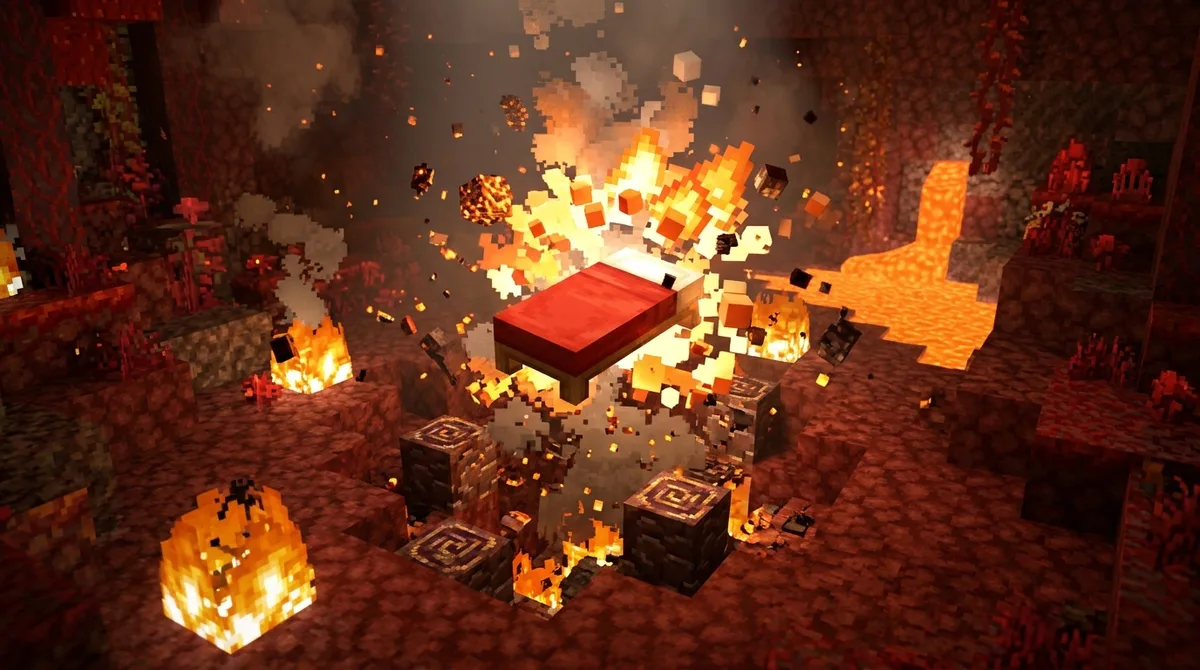
Players use bed blasts in the Nether to break ancient debris faster than they could by mining it alone. The explosion destroys the blocks around the bed, so a debris vein close to the bed can be cleared in one blast. A common setup is a Nether tunnel with a bed set into one wall, right beside the debris.
The Minecraft Wiki’s ancient-debris bed-mining guide advises standing 6 blocks from the bed’s explosion. Mojang’s mining guidance also recommends putting a solid block between you and the bed. Netherrack or obsidian both work, because the block sits in the line of the blast and lowers how much of you the explosion can reach.
Picture a tunnel with netherrack walls and floor, and a vein of ancient debris just above the spot where you want the bed. Clear any wooden planks, grass, or other flammable blocks nearby first, since Java Edition explosions can set surrounding blocks on fire. Then follow these steps:
- Dig a small pocket into the tunnel wall, just below the debris vein.
- Place the bed in that pocket with its head pointing at the debris.
- Place a netherrack or obsidian block in the tunnel between you and the bed.
- Walk back until you are 6 blocks from the bed, keeping the shield block between you and it.
- Right-click the bed to try to sleep, and wait for the blast to open the vein.
- Walk back up the tunnel to the staircase you cut on the way in, which leads to solid ground away from lava.
Plan your return route before you start. If the blast leaves you hurt or on fire, you want a clear path out of the tunnel, not a search for the staircase.
Can Bed Explosions Hurt the Ender Dragon?
Yes. The Minecraft Wiki’s combat tutorial says bed explosions can significantly damage the Ender Dragon, and the damage is greatest when the blast goes off near the dragon’s head. That is why the head is the spot to aim for when you set up your bed.
Watch the dragon before you place anything. It flies around the central island and dives toward players, so a bed set where it is likely to pass or perch gives you a better chance of landing the blast on its head. A bed the dragon never gets close to won’t do you any good.
You’ll be standing in the same blast zone, so plan your own spot first. Stand at the foot end of the bed, keep a solid block between you and the blast, and back away as far as the room allows. Choose your exit before the fight starts, so you can move off the blast’s path right after it goes off.
Go in with full health and a stack of food. Keep a few blocks in your inventory so you can throw up quick cover if the dragon swoops in before the bed is ready.
Turning Off Bed Explosions on Bedrock Edition
Bedrock Edition lets you control this behavior with the respawnBlocksExplode game rule. It decides whether beds and respawn anchors explode in other dimensions. The rule’s default value is 1, which means beds explode in the Nether and End unless you change it, as described in Microsoft’s Bedrock Edition game rule documentation.
If you want to stop the blasts, change the rule’s value. Here’s how to do it:
– Open your Bedrock world with cheats turned on. – Open the chat and type /gamerule respawnBlocksExplode false. – Try to sleep in a bed in the Nether to confirm that nothing explodes.
Set the rule back to 1 whenever you want the explosions to return. Check the value before you plan a debris run or a dragon fight, so you know whether the bed will blow.
Java Edition does not use this game rule, so the setting only applies to Bedrock worlds. Typing the command on Java won’t change how beds behave there.
How Do You Stay Safe Near a Bed Explosion?
The safest habit is to set your spawn point in the Overworld before you travel into the Nether or the End. A bed in either dimension explodes instead of saving your spawn, so sleep in a bed back home first. Then you’ll always have a respawn point waiting if a trip goes wrong.
Plan your Nether base so the blasts never reach the rooms you use every day. Keep any bed you place at least 10 blocks from the spots you visit most, since that is how far the blast reaches. Fill the space between them with solid blocks such as netherrack, stone, or obsidian. Every block in the line of the blast cuts the damage on the far side.
Pay special attention to these three areas:
– Portal room: Keep the bed out of the room where you light and step through your portal, so a blast never blocks your way back. – Storage room: Wall off your chests with netherrack so a nearby bed can’t break open your supplies. – Mining tunnel: Use a side pocket you can avoid, not a passage you walk through every trip.
Never place a bed in a tight tunnel you have to walk through. The blast can clear the blocks along that route and leave you with a gap in the walls, or with lava suddenly close to your path. Choose a side pocket or a dead-end room instead, and make sure you can walk around the bed without squeezing past it.
Planning Safe Nether Trips Around Your Beds
Your next step is to pick one goal and write the plan down before you light a portal. Decide whether you’re mining ancient debris or going after the Ender Dragon, because each job puts the bed in a different spot. Sketch the tunnel or the island on paper and mark where the bed’s head will sit.
Then check your edition. Bedrock players should confirm the respawnBlocksExplode value before they leave, since a switched-off rule changes the whole plan. Java players can skip that check, because Java beds explode in the Nether and End with no game rule to flip.
Next, measure your spacing. For a debris run, mark a spot 6 blocks from the bed and make sure a solid wall sits between that spot and the blast. For a dragon fight, pick a backup spot at the foot end of the bed, with enough open floor to back away quickly.
Before you leave the Overworld, sleep in a bed there so your spawn point is saved somewhere safe. Pack a stack of netherrack for cover, a few blocks for emergency walls, and enough food to recover from a rough blast. Finally, walk your planned route once with no bed placed, so you know exactly where to go when the explosion hits.