
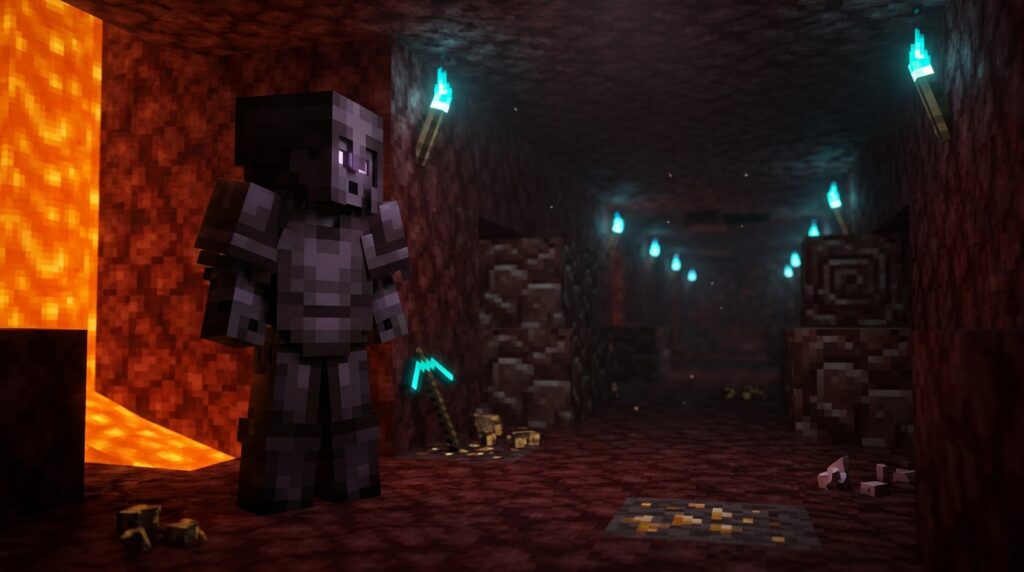
Hunting for Ancient Debris in the Nether can feel like looking for a needle in a haystack if you do not know where to dig. To save time and avoid wasting your pickaxes, you should focus on the most efficient mining levels where the rarest ore in the game hides. While you can find debris anywhere from the bottom of the world up to the ceiling, the game code uses a triangular distribution that makes one specific spot much better than the rest.
The absolute sweet spot for your mining tunnel is Y-level 15, which offers the highest concentration of Ancient Debris in both Java and Bedrock editions. Most of your loot will appear between levels 8 and 22, so staying in this range ensures you are not just digging through endless blocks of netherrack for nothing. Since large lava lakes usually sit higher up at Y-level 31, sticking to level 15 keeps you relatively safe while you use beds or TNT to blast your way to a full set of netherite gear.
Key Takeaways
- Target Y-level 15 to find the highest concentration of Ancient Debris due to the game’s triangular distribution of ore.
- Mine between Y-levels 12 and 15 to stay safely below the Nether’s massive lava lakes, which typically generate at Y-level 31.
- Utilize beds or TNT to clear large areas of Netherrack quickly, as Ancient Debris is blast-resistant and will remain intact after the explosion.
- Use the F3 debug screen in Java Edition or the ‘Show Coordinates’ setting in Bedrock Edition to ensure you are positioned at the optimal vertical height.
Target Y Level Fifteen For Maximum Density
To get the best results for your mining trip, you should head straight down to Y-level 15. While Ancient Debris can technically appear anywhere from Y=8 to Y=119, the game uses a triangular distribution that concentrates the most ore at this specific height. By placing your feet at this level, you are positioning yourself right in the middle of the highest density zone. This mathematical sweet spot ensures that every block you clear with a bed or a piece of TNT has the highest possible chance of revealing that rare ore. You will find that mining here is far more productive than wandering through the higher reaches of the Nether.
Checking your current position is easy if you are playing on the Java Edition of the game. Just tap the F3 key on your keyboard to bring up the F3 debug screen, which displays text and numbers on your monitor. Look for the line that says XYZ on the left side to see your exact coordinates in the world. The middle number represents your vertical height, so you want to dig down or build up until that number reads 15. Once you are there, you can close the screen by pressing F3 again and start your search for netherite.
Staying at this depth also offers a great balance between finding ore and staying safe from environmental hazards. Most of the massive lava lakes in the Nether generate at Y-level 31, which means you are safely tucked away beneath those giant pools of fire. While you might still run into small pockets of lava hidden in the walls, you will not have to worry about a massive flood ruining your progress. This level is perfect for using the bed mining strategy because the explosions will clear out huge areas of netherrack without hitting the ceiling of the lava sea. Stick to Y-level 15 to maximize your hourly yield while keeping your gear safe from unexpected accidents.
Navigate The Danger Zone Below Lava Lakes

When you head into the Nether to hunt for Ancient Debris, your main goal is to find that perfect balance between safety and efficiency. While the highest concentration of this rare material peaks at Y=15, digging exactly at that level puts you near hidden lava pockets. By dropping your mining path down to Y=12, you position yourself safely below the massive lava lakes that typically fill the caverns at Y=31. This strategic depth allows you to use explosive methods like beds or TNT without worrying about a sudden wall of lava flooding your tunnel. You are still well within the high-density range of the triangular distribution, ensuring your hourly yield remains high while your risk of a fiery death stays low.
Traditional strip mining can be slow, but mining at Y=12 gives you the perfect floor to clear out large areas quickly. At this elevation, you can easily reach upward to expose the debris clusters that frequently spawn between Y=13 and Y=17. Because Ancient Debris is incredibly blast-resistant, you should use beds or TNT to create massive clearings that reveal the blocks hidden deep inside the netherrack. This specific mathematical optimization ensures you are seeing the most blocks possible per minute of work. You will spend less time bridging over lava and more time collecting the materials you need for your full set of netherite gear.
Focusing your efforts on the Y=12 to Y=14 range is a smart way to handle the dangers of the Nether while maximizing your loot. Even though Ancient Debris can technically appear anywhere from Y=8 to Y=119, the mathematical sweet spot is much narrower. Staying slightly lower than the peak distribution level acts as a natural shield against the unpredictable fluid mechanics of the Nether. You can move faster, see more terrain, and keep your inventory safe from accidental incineration. It is the most effective way to turn a dangerous grind into a productive and rewarding mining session.
Optimize Blast Radius With Bed And TNT
To maximize your hourly yield of Ancient Debris, you need to position yourself at Y-level 15 before reaching for your explosives. While this rare material can generate anywhere from the bottom of the Nether to the ceiling, the game uses a triangular distribution that peaks right at this specific coordinate. By standing at Y=15, your blast radius will clear out the Netherrack where the concentration of debris is statistically at its highest. This mathematical sweet spot ensures that every bed or piece of TNT you detonate covers the most productive layers of the world. Staying around this level also keeps you safely below the massive lava lakes that typically pool at Y=31.
Using beds is a cost-effective way to clear massive amounts of space because they create an explosion larger than standard TNT. To do this safely, dig a long tunnel at Y-level 15 and create small side pockets every few blocks to place your bed. Make sure to place a solid block between you and the bed before right-clicking to sleep, as this protects you from the lethal blast damage. The explosion will vaporize the surrounding Netherrack but leave the blast-resistant Ancient Debris fully intact and easy to spot. This method allows you to see through dozens of blocks in seconds, revealing the hidden ores that would take hours to find with a traditional pickaxe.
If you have a gunpowder farm, using TNT can be a faster and more precise alternative for your mining operation. You can chain several blocks of TNT together at Y=15 and ignite them from a distance to reveal a long corridor of potential debris. This approach is often safer than using beds because you can trigger the explosion from a much further distance using redstone or a bow with Flame. Since Ancient Debris is one of the few blocks in the game that can survive these blasts, you can simply walk through the newly cleared cavern and collect your prizes. Mixing these explosive strategies at the correct Y-level is the most efficient way to master netherite upgrade smithing and gear up with full Netherite.
Final section
To get the most out of your mining session, you should focus your efforts specifically on Y-level 15. While Ancient Debris can be found anywhere from the bottom of the world up to the ceiling, the game uses a triangular distribution that peaks at this exact coordinate. By staying at Y-15, you are mathematically maximizing your chances of finding those rare brown blocks. Whether you are using TNT or beds to blast through the Netherrack, this level provides the highest density of debris for your time.
Safety is just as important as efficiency when you are deep underground in the Nether. Large lava lakes typically sit at Y-31, but you will still run into small pockets of lava hidden behind the walls at lower levels. Always keep a few Fire Resistance potions on your hotbar so you can react quickly if a sudden spill happens. Mining around Y-12 to Y-14 is a great alternative if you want to stay slightly below the peak density to avoid some of these hazards while still finding plenty of materials. If you find the grind too slow, you can always learn how to find diamonds fast and other rare ores using specialized visual tools.
Once you have gathered enough Ancient Debris, you can finally head back to your base to smelt it into Netherite Scraps. Combine those scraps with gold ingots to create the bars needed for your gear upgrades at a Smithing Table. Remember that you will also need a Smithing Template found in Bastion Remnants to complete the process in the latest versions of the game. With your new armor and tools, you will be ready to take on any challenge the Nether throws your way.
The Best Y-Level for Ancient Debris
Finding the most efficient netherite mining level comes down to mastering the mathematical peak of Ancient Debris generation. You should focus your efforts specifically on Y-level 15, as this is where the game triangular distribution of ore reaches its highest concentration. While you can find debris anywhere between Y-level 8 and 22, sticking to the middle of this range maximizes your chances of hitting a vein. By positioning yourself at Y-15, you are perfectly placed to see the most valuable blocks above and below your feet. This narrow window is the proven sweet spot for both Java and Bedrock players looking to upgrade their gear quickly.
Safety is just as important as speed when you are digging deep under the Nether surface. Large lava lakes usually sit at Y-level 31, but you still need to watch out for small hidden pockets of lava that can ruin your day. Some players prefer to mine slightly lower at Y-level 12 or 13 to stay well below these common hazards while remaining in the high-density zone. Since Ancient Debris is incredibly blast-resistant, using beds or TNT at these levels is the fastest way to clear out massive areas of netherrack. This explosive strategy combined with the right Y-level will give you the best hourly yield of scraps.
Frequently Asked Questions
1. What is the absolute best Y-level for finding Ancient Debris?
You should head straight to Y-level 15 for the best results. While Ancient Debris spawns at various heights, the game concentrates the most ore at this specific level to give you the highest chance of success.
2. How do I check my current Y-level in the game?
If you are playing on Java Edition, simply press the F3 key to open your debug screen and look for the XYZ coordinates. On Bedrock Edition, you can turn on Show Coordinates in your world settings to see your position in the top corner of your screen.
3. Is it safe to mine for Netherite near lava lakes?
Sticking to Y-level 15 is actually quite safe because most large lava lakes sit higher up at level 31. By staying at this lower depth, you can blast through netherrack with beds or TNT without worrying about a massive flood of lava ruining your progress.
4. What is the total range where Ancient Debris can spawn?
Ancient Debris can technically show up anywhere between Y-level 8 and Y-level 119. However, you will find the most loot between levels 8 and 22, which is why focusing on the middle of that range is so important.
5. Why is Y-level 15 better than mining at other heights?
The game uses a triangular distribution to spawn Ancient Debris, which means the density peaks right at Y-level 15. Mining here ensures you are in the mathematical sweet spot where the most ore blocks are packed together.
6. What are the most efficient tools for clearing out netherrack?
Using beds or TNT is the fastest way to find Ancient Debris because these explosions clear huge areas of netherrack instantly. Since Ancient Debris is blast resistant, it will remain floating in the air even after the surrounding blocks are destroyed.