
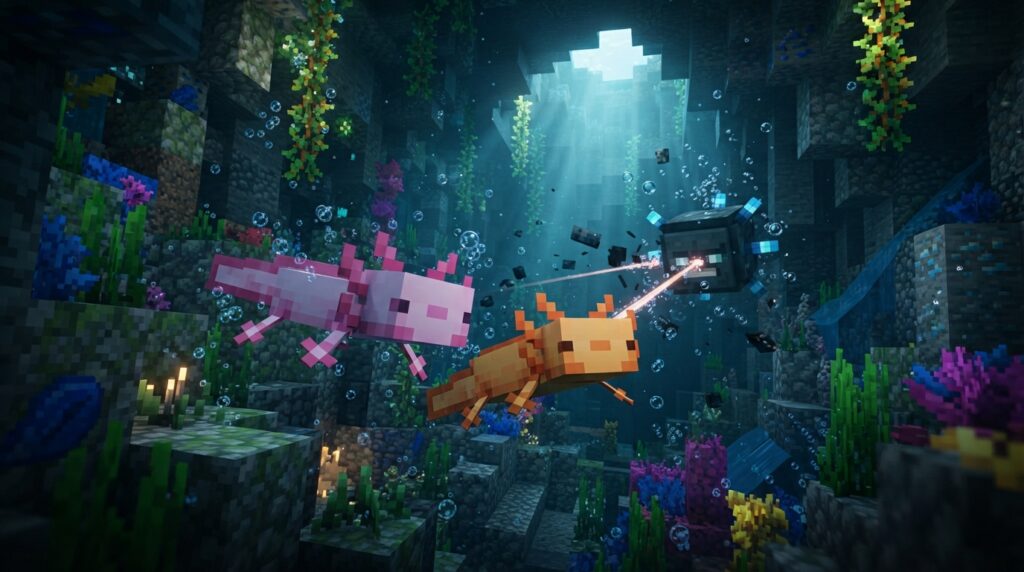
Finding an axolotl is exciting, but keeping one safe and breeding the rare blue variant takes more than a bucket. This Minecraft axolotl guide explains where axolotls spawn, how to collect and breed them, what they eat, and how to build a safe home for your aquatic companion.
Axolotls can fight many underwater enemies, play dead to recover, and appear in five colors. The blue variant has only a 1-in-1,200 chance of appearing when you breed non-blue axolotls. You’ll also learn how baby axolotls grow and how their appearance, sounds, and ability to stay young work.
Key Takeaways
- Find axolotls in lush caves, especially in underground water pools above clay near azalea trees. Capture them with Water Buckets so they can be transported safely without wandering away.
- Build a secure, water-filled habitat with solid walls, a roof, and at least two blocks of depth; axolotls can take damage after roughly five minutes out of water.
- Breed two adult axolotls with Buckets of Tropical Fish. Baby axolotls mature in about 20 minutes, while the blue variant has only a 1-in-1,200 chance of appearing when breeding non-blue parents.
- Axolotls are valuable underwater combat allies against hostile mobs such as guardians and drowned. They can play dead to recover, but still need protection and should be collected in buckets after a fight.
Lush Cave Axolotl Spawning
Lush caves are the best place to search for axolotls. Azalea trees are your main clue that one may be nearby underground. Dig carefully below an azalea tree, then explore until you find moss, glow berries, and underground water pools. Check pools with clay nearby, since axolotls commonly spawn in water above clay-filled areas. Bring torches, food, and a bucket so you can explore safely and collect an axolotl when you find one. Axolotls spawn in water, not on ordinary land, so check every small pool instead of searching only across dry cave floors.
You can find five axolotl color variants: lucy, wild, gold, cyan, and blue. Lucy axolotls are pink, wild axolotls are brown, gold axolotls are yellow, cyan axolotls are light blue, and blue axolotls are the rarest. Use a Water Bucket on an axolotl to pick it up, then carry it home without worrying about it wandering away. Searching several lush caves can help you find different colors, and breeding axolotls can produce new variants. Once you release them in a pond or underwater base, they can help you fight hostile aquatic mobs.
Bucket Capture And Safe Habitats
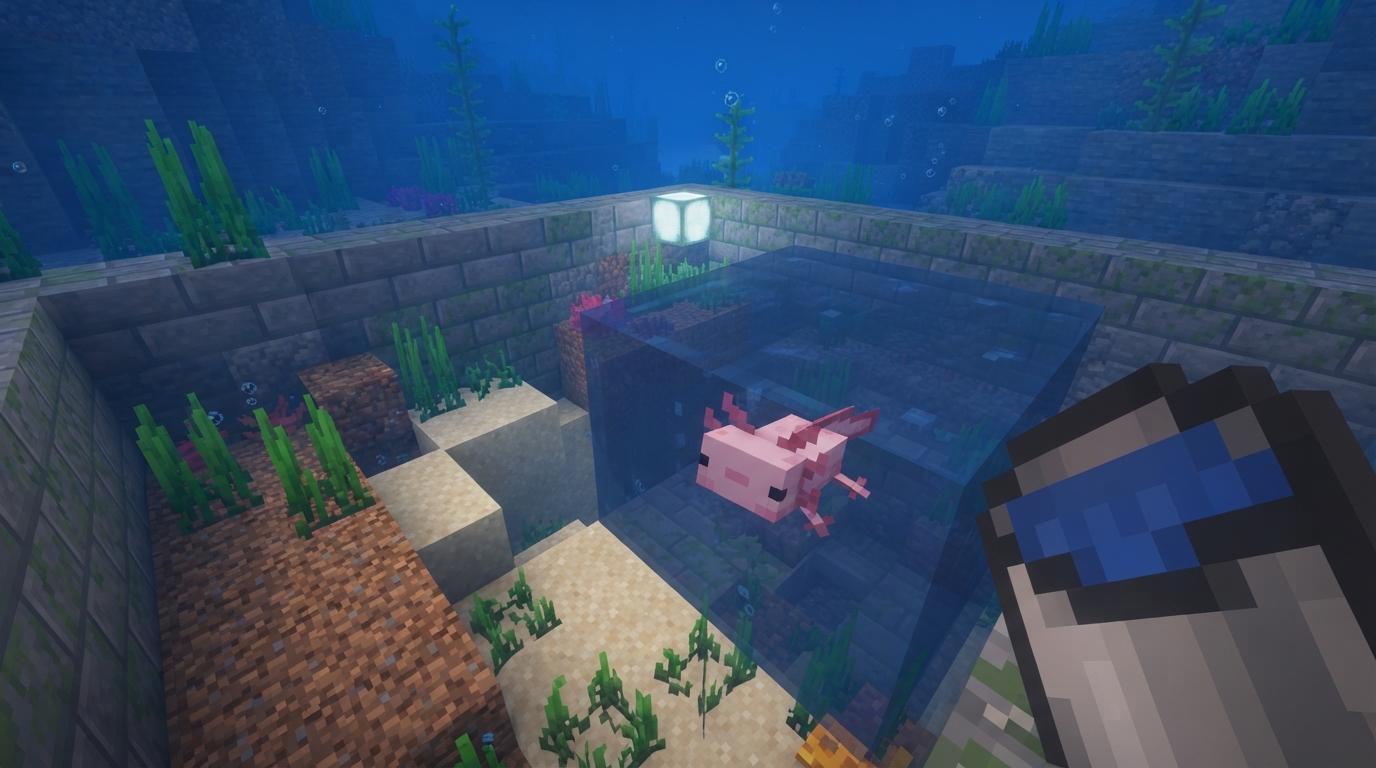
Capture an axolotl by using a Water Bucket on it, just as you would collect a fish. The axolotl goes inside the bucket, so it will not wander away while you travel through caves, climb to the surface, or make a long trip home. Keep it in the bucket when moving through dangerous underground areas, since an axolotl cannot follow you safely across dry ground. To release it, use the Axolotl Bucket on a water-filled enclosure. This places the axolotl in the water.
Build the habitat before you release your axolotl. Use deep water, solid walls, and a roof to prevent escapes. A pool at least two blocks deep gives it room to swim, while glass or other solid blocks let you watch it without leaving gaps. Add torches, lanterns, or other lighting around the enclosure so you can see clearly and reduce nearby hostile mob problems. Keep the axolotl in water whenever possible. It cannot stay on land for long and begins taking damage after roughly five minutes out of water. If you need to move it again, scoop it up with a Water Bucket instead of guiding it across a dry path.
Breeding Axolotls And Rare Variants
Breed axolotls by feeding a Bucket of Tropical Fish to two adult axolotls. They produce one baby, and each parent has a five-minute breeding cooldown. Baby axolotls take about 20 minutes to grow into adults, but you can shorten this time by feeding them more Buckets of Tropical Fish. Each feeding removes 10% of the baby’s remaining growth time, so keep extra tropical fish ready if you want adult axolotls sooner.
The blue axolotl is the rarest variant, with only a 1-in-1,200 chance of appearing when you breed two non-blue parents. Because the chance is so small, keep breeding every pair you can and protect the babies while you wait for a blue one. When you get a favorite axolotl, use a Name Tag on it to give it a permanent name and make it easier to identify. A name such as “Blue Guardian” can help you recognize it among several axolotls in your base.
Move baby axolotls safely by scooping them into a Water Bucket. Then place them in a permanent habitat with plenty of water and solid walls. An enclosed aquarium, underground pool, or lush-cave-style pond keeps them from wandering away and gives you a safe place to raise them. Include enough space for adults to swim, and keep the habitat away from hazards such as hostile mobs and open lava. Once your axolotls are settled, you can continue breeding them for combat partners and rare color variants.
Axolotls In Underwater Combat

Axolotls can attack many aquatic enemies, making them useful allies during underwater fights. They can target threats such as guardians, drowned, elder guardians, and other hostile underwater mobs while remaining passive toward you. Each axolotl has 14 health points, equal to seven hearts, so it can survive some damage but still needs protection during a long battle. Carry one in a Water Bucket, then release it near the enemies you want it to fight.
When an axolotl takes heavy damage, it may play dead instead of continuing to attack. This can trigger regeneration, helping it recover while enemies lose interest for a short time. Before raiding an ocean monument, release several axolotls near the entrance or around a group of guardians. Keep your own escape route open with a tunnel, air pockets, or a nearby water exit. Do not rely on axolotls alone, since guardians can still defeat them. Collect any survivors in buckets when you retreat.
Find, Carry, and Breed Axolotls
Axolotls are easiest to find in lush caves, where they spawn in underground water-filled areas. Bring several Water Buckets so you can scoop them up safely and carry them home without leads or boats. Once you have two axolotls, breed them with Buckets of Tropical Fish to grow your group and possibly get new color variants. The blue axolotl is especially rare, with only a 1-in-1,200 chance when breeding non-blue parents. Lucy, wild, gold, and cyan axolotls are more common.
These small fighters are passive toward you but attack many aquatic enemies, making them helpful during ocean monument raids, underwater ruins, and other water battles. When an axolotl helps you defeat a hostile aquatic mob, you may receive a short Regeneration effect. Keep your axolotls close when exploring dangerous areas. Build a protected axolotl pool with water, solid walls, and a roof so your collection stays safe from nearby threats. When you are ready for a bigger challenge, take a small group in buckets on your next ocean adventure and release them near the fight.