
Minecraft advancements are Java Edition objectives organized into themed branches. Use a searchable roster labeled for your game version to find goals; Bedrock Edition has a separate achievement system.
Use the list to check your progress and choose a challenge that fits your play style. It covers Java Edition, not Bedrock Edition, which has a separate achievement system. Requirements can change between releases: Java 1.21.6 added two advancements, and 1.21.11 updated existing criteria. Match your checklist to your game version. Advancements are saved per world, and you can complete one without first earning its displayed parent, as explained in the Minecraft Wiki’s overview.
Key Takeaways
- Java advancements include themed goals such as Adventuring Time and Caves & Cliffs.
- Check the exact requirement for your Java version before planning a goal, because Java 1.21.6 added two advancements and Java 1.21.11 changed existing criteria.
- Java advancements and Bedrock achievements are separate systems, so confirm your edition before using a checklist.
- Advancement progress is saved separately for each world, and you can earn a displayed child advancement without completing its displayed parent first.
- Choose a goal that fits your session, such as Arbalistic or Great View From Up Here.
What Is on the Minecraft Advancements List?
The Minecraft Java Edition advancements list covers goals for exploration, combat, and unusual survival challenges. Each entry gives you specific conditions to meet. A categorized checklist helps you scan branches, compare requirements, and find a goal that interests you.
Arbalistic is a combat challenge. Check its listed criterion for your game version to confirm what you need to do.
Great View From Up Here is another named advancement. Check its listed criterion for your game version to see what the challenge requires.
The categorized checklist lets you scan advancement names and requirements by branch. Use the listed criteria to compare challenges and choose one that suits your session.
How Is the Java List Organized?
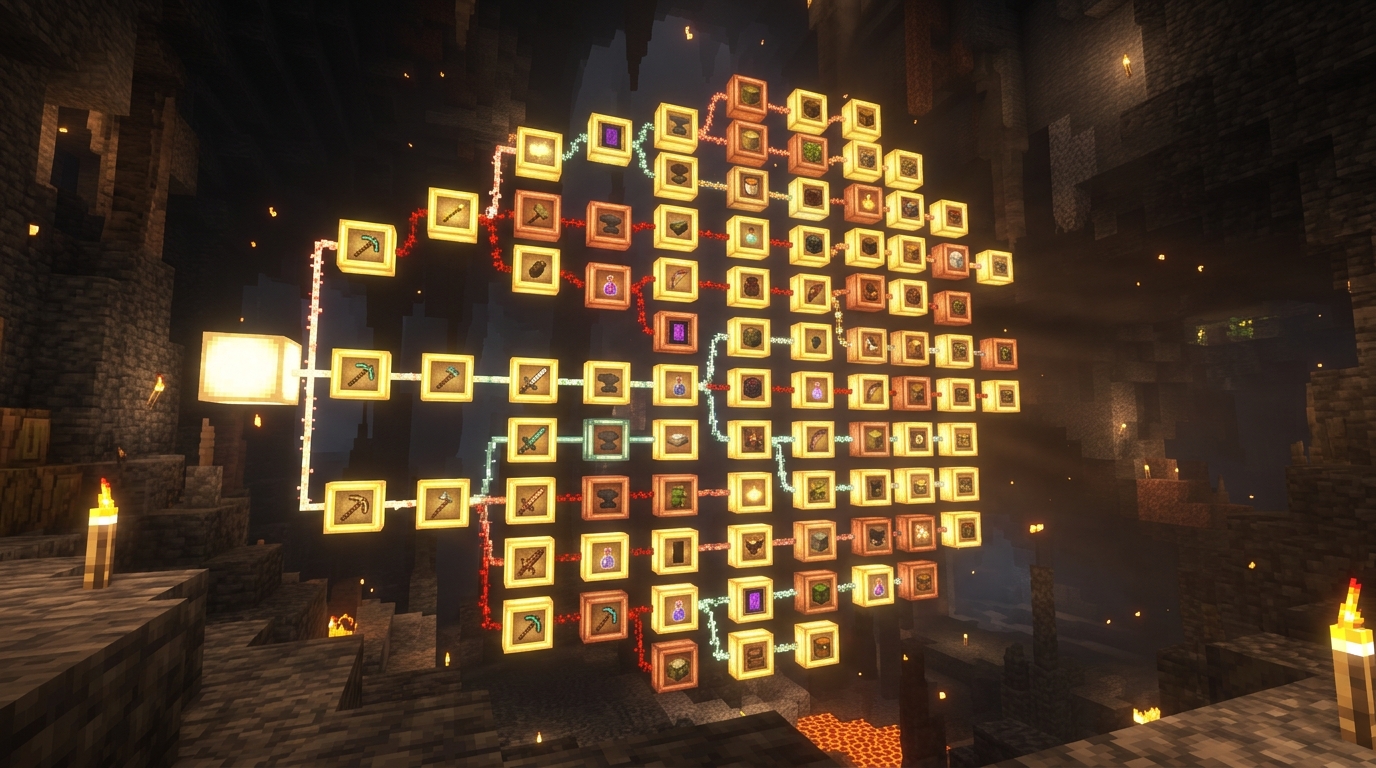
The Java list is organized into themed advancement branches, with each goal shown by its name and criteria. Branches vary in size. Treat the examples below as a sample checklist, not the complete roster.
Search for an advancement by its exact name, then read its requirement to confirm what counts. A title may hint at the challenge, but the listed criterion tells you what to do. Experience rewards are included where available; no reward figures are provided for these examples.
| Advancement | Requirement | Experience reward |
|---|---|---|
| Monster Hunter | Check the criterion for your game version. | Not listed here |
| Stay Hydrated! | Check the criterion for your game version. | Not listed here |
| Heart Transplanter | Confirm the listed requirement matches your Java version. | Not listed here |
| How Did We Get Here? | Check the criterion for your game version. | Not listed here |
The tree’s connecting lines show displayed parent advancements, but a parent is not a prerequisite. Java advancements are independent, so you can complete a goal without first earning the advancement shown above it.
For a quick checklist, record each goal by its exact title and keep its criteria beside it. This helps you distinguish a straightforward combat objective, such as Monster Hunter, from a more involved challenge, such as How Did We Get Here? You can also check the criterion again if its wording differs between game versions.
Which Advancements Make Good Challenges?
These four challenges test exploration, combat, survival, and movement in different ways. Compare their exact requirements in the searchable Java advancement roster, then choose the play style you want to focus on.
- Adventuring Time: Visit 56 specified biomes. The challenge rewards 500 experience points and suits you if you enjoy exploring and tracking where you’ve been.
- Arbalistic: Defeat five distinct entity types with one crossbow projectile. The reward is 85 experience points. This combat goal requires a single shot to meet a demanding target condition.
- Caves & Cliffs: Survive a fall of at least 379 blocks, starting at Y 319 or higher and ending at Y -59 or lower. This challenge centers on a precise, extreme drop.
- Great View From Up Here: Rise at least 50 vertical blocks while affected by Levitation. The reward is 50 experience points, making this a movement goal focused on gaining height under an effect.
The goals vary in difficulty and pace. Adventuring Time spreads the work across many locations, while Arbalistic depends on one projectile defeating several kinds of entity. Caves & Cliffs sets a strict starting and ending height for a fall, while Great View From Up Here asks you to gain height. These requirements help you tell a broad exploration task from a focused combat or movement challenge. Check the named criteria in the searchable roster against your Java version, especially when comparing goals with different setups. Pick Adventuring Time for exploration, Arbalistic for combat, or Great View From Up Here for a movement challenge. Caves & Cliffs offers a distinct survival test.
What Changed in Recent Java Versions?
Recent Java versions changed the number of advancements and the requirements for some goals. Official release notes document two new advancements in Java 1.21.6, while Java Edition 1.21.11 updates criteria for existing advancements.
These changes affect how you should use a checklist. A familiar advancement name may have a different requirement in another release, so the title alone doesn’t confirm that an older guide describes the goal in your game. Check the criterion for your exact Java version before planning a challenge.
Add a version label to each checklist entry, such as “Java 1.21.6” or “Java 1.21.11,” and keep the requirement beside the advancement name. If a guide doesn’t give a version, treat its criteria as unconfirmed rather than assuming they match your world. This helps when you return to a saved checklist after updating Minecraft.
An older Java list may help you recognize familiar advancement names, but don’t treat it as a current checklist. New goals and changed criteria can make its entries incomplete or outdated. Use a guide labeled for your version, and recheck any requirement that matters to your plan, such as the exact condition for completing a combat or exploration goal.
How Do Java and Bedrock Goals Differ?
Minecraft Java Edition uses advancements, while Minecraft Bedrock Edition has a separate achievement system. The systems are distinct, so a Java advancement checklist isn’t a Bedrock achievement list, even when both describe goals you can pursue in Minecraft.
Before using a requirement, confirm which edition you play. Check the edition name in your launcher or game information, then look for a list labeled for that edition. If you launch Java Edition, search for Java advancements. If you play Bedrock Edition, search for Bedrock achievements. The edition label matters because a requirement written for one system may not match the goals or wording in the other.
For example, a Java guide might describe the exact condition for earning a named advancement, such as Monster Hunter. That entry doesn’t tell you the requirements for a Bedrock achievement. Search using your edition and the goal’s name, and check that the guide identifies the right system before planning an in-game challenge. If you’re unsure which result applies, verify your edition first instead of assuming an advancement roster covers both versions.
How Can You Track or Grant Advancements?
You can track Java advancements in the in-game screen, compare them with the article’s searchable checklist, and use /advancement to grant or revoke them. You can complete advancements in any game mode, and Minecraft saves their progress separately for each world.
Use these steps to check a goal or adjust a world’s advancement record:
- Open the advancement screen in the world you want to track, then find the branch and advancement you’re working on.
- Search the article’s checklist for the exact advancement name and compare its requirement with the one shown in your game.
- Check the requirement itself, not just the tree layout. You don’t have to complete a displayed parent before earning its child advancement.
- If you want to change the record instead of earning the goal through play, use
/advancementto grant or revoke the advancement.
Because progress is saved per world, completing a goal in one save doesn’t mark it complete in another. Check the advancement screen in the specific world whose progress you want to compare. The command can also help correct a world’s record, but you don’t need it to track ordinary gameplay progress.
Choose Your Next Advancement
Choose one unfinished advancement from the screen in the world you plan to play next. Write its exact name and requirement on a short checklist, then pick a second goal as a backup in case your first choice doesn’t fit that session.
For an exploration session, choose Adventuring Time. For a focused combat attempt, choose Arbalistic. For a movement challenge, choose Great View From Up Here. Check the criterion for your game version before planning each goal.
Choose Caves & Cliffs when you want a survival challenge. Check its criterion for your Java version and keep the requirement beside the advancement name before trying it.
Before you begin, compare the checklist entry with the criterion shown in your world. Mark the goal complete only after the game records it, then choose another unfinished advancement for your next session. A short, version-labeled list with one main goal and one backup makes your next step clear without turning the whole roster into a to-do list.