
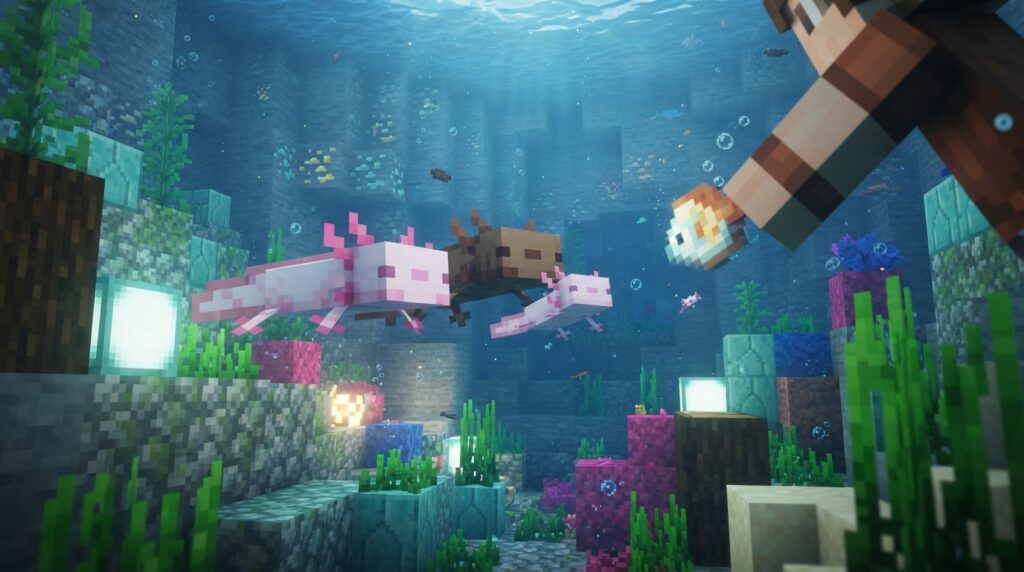
To breed axolotls in Minecraft, feed two adults one Bucket of Tropical Fish each. In Bedrock Edition, axolotls spawn underwater in lush caves, and clay is a required spawning clue. Microsoft Learn’s reference lists groups of four to six. Search cave water near clay, but treat this as a Bedrock clue, not a rule for every edition.
Baby axolotls take about 20 minutes to grow into adults. Parents have different cooldowns after breeding: five minutes in Java Edition and one minute in Bedrock Edition. A baby has a 1-in-1,200 chance of being blue, so no parent pairing guarantees that color. Once you have a blue axolotl, each new baby has a 50% chance of inheriting blue. Keep babies in water as they grow.
Key Takeaways
- To breed axolotls, feed each of two adults one Bucket of Tropical Fish, then keep the parents and baby in an enclosed water pool.
- Axolotl parents can breed again after five minutes in Java Edition or one minute in Bedrock Edition, and each baby takes about 20 minutes to grow into an adult.
- A baby axolotl has a 1-in-1,200 chance of being blue when neither parent is blue, while a blue parent gives each baby a 50% chance of inheriting blue.
- In Bedrock Edition, search underwater areas of lush caves near clay for axolotls; treat clay as an edition-specific spawning clue, not a rule for every edition.
How Do You Breed Axolotls in Minecraft?
To breed axolotls, find two adults and feed each one a Bucket of Tropical Fish. Find the axolotls, bring a bucket of tropical fish for each parent, then breed them in a safe water area and protect the baby there.
Before bringing the axolotls together, prepare an enclosed pool with water and solid walls. A small, enclosed area makes it easier to feed both parents and keep the baby from swimming away. Prepare the pool before transporting the axolotls so they have a safe place to go.
Bring at least two Buckets of Tropical Fish, one for each adult. Tropical fish by themselves are not the breeding item, so catching fish without putting them in buckets will not work. Use a Bucket of Tropical Fish on one adult, then use another on the second adult. Once both axolotls have been fed, they can breed and produce a baby.
Keep the parents and baby in the enclosed pool after breeding. Check that the area is covered with water and that there are no gaps in the walls. A contained pool helps you keep track of the baby as it grows, rather than letting it swim into nearby cave passages or out of the water.
Where Can You Find Axolotls?
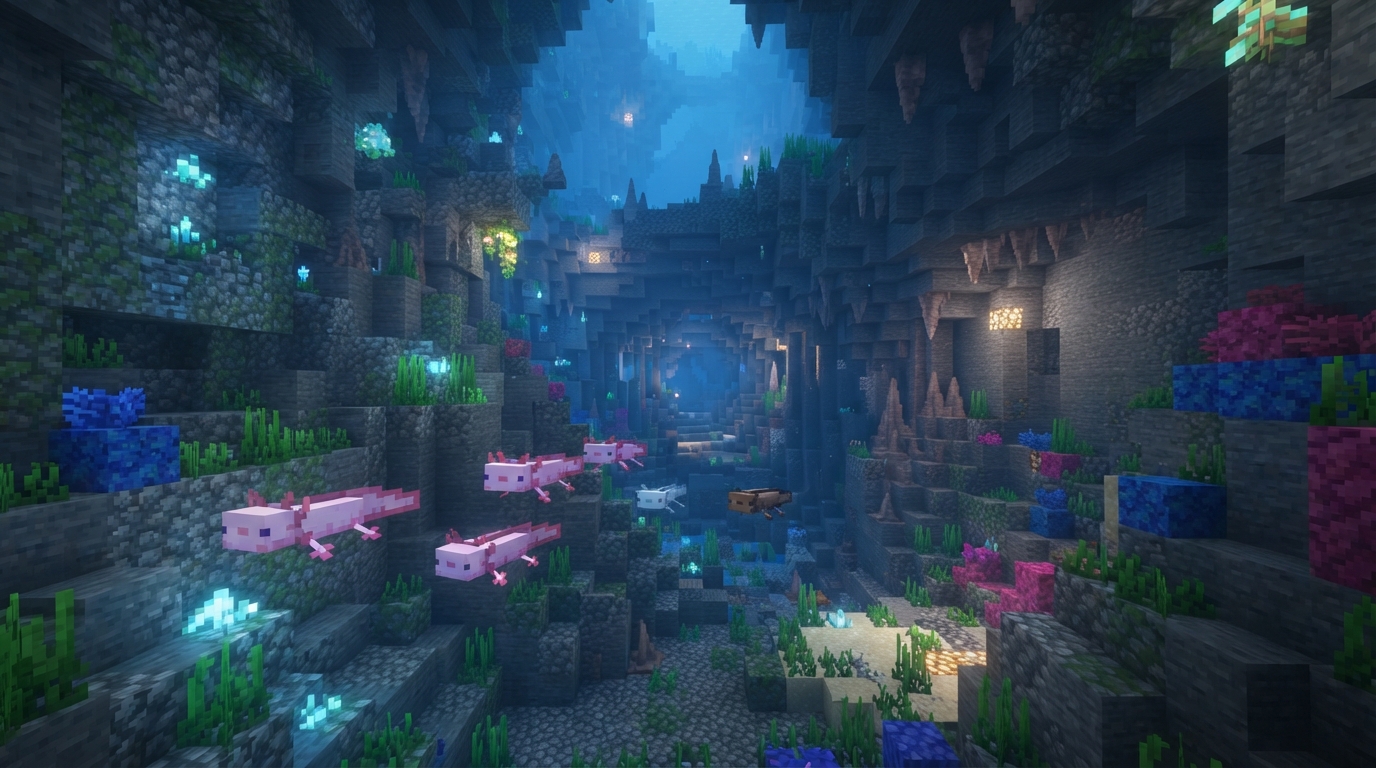
You can find axolotls in underwater areas of lush caves, so search cave pools rather than dry passages. In Minecraft Bedrock Edition, Microsoft Learn’s spawn reference specifies underground, underwater spawning in lush caves and lists clay as a required spawning-block filter. Use this as a Bedrock search clue, not a rule for every edition.
As you explore underground, look for a lush cave and check its water-filled areas for clay. Axolotls won’t appear in dry stretches of cave: the Bedrock reference points to underwater spawning, with clay as part of the condition. Check the blocks around the water as well as the pool itself, since finding the right biome alone may not provide the clay clue.
The same Microsoft Learn Bedrock spawn reference gives a herd size of four to six and an underground density limit of five. These details can help you set expectations when searching in Bedrock, but they don’t guarantee that every suitable pool will contain axolotls. If you find a group, check nearby underwater areas for other suitable spawning spots.
For a focused search, explore the water in a lush cave, scan for clay, and try another underwater area if you find only dry passages. Treat the Bedrock figures as edition-specific clues, especially if you’re playing Java Edition.
What Food Do You Need to Breed Them?
Axolotls breed when you feed each adult a Bucket of Tropical Fish. Holding tropical fish as an item does not trigger breeding. Prepare a separate bucket for each adult, then follow these steps to feed the pair and keep them together.
- Place two adult axolotls in a contained water area. Enclosing the pool helps keep both parents nearby while you feed them.
- Hold a Bucket of Tropical Fish and use it on the first adult axolotl. The bucket must contain the fish; a tropical fish item in your hand will not work.
- Use a second Bucket of Tropical Fish on the other adult. Both axolotls need to be fed before they can breed.
- Give the fed pair room to breed and produce a baby axolotl. After breeding, the parents have a five-minute cooldown in Minecraft Java Edition or a one-minute cooldown in Minecraft Bedrock Edition.
- Keep both adults and the baby inside the contained water area. The same pair can breed again after its cooldown ends, as long as you feed each adult another Bucket of Tropical Fish.
How Do Axolotl Colors Work?
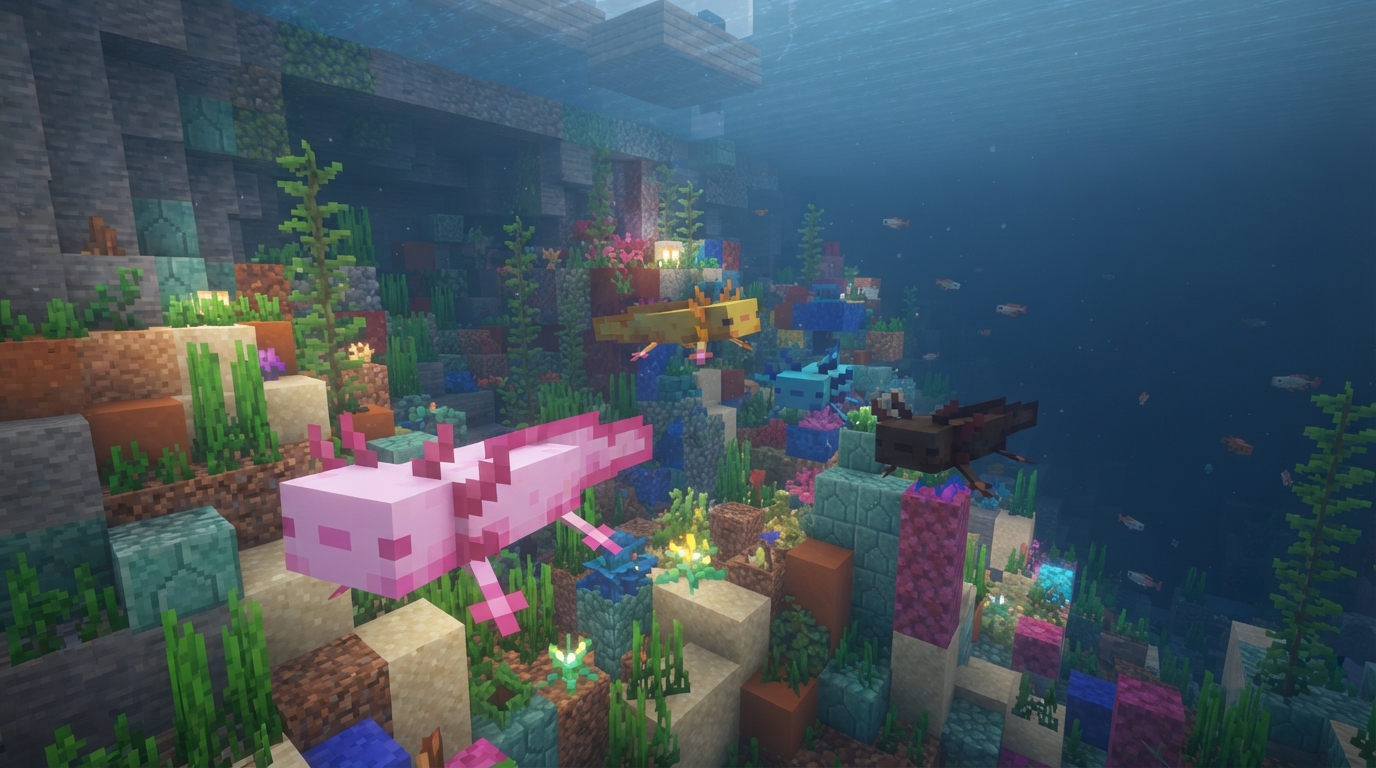
Minecraft has five axolotl colors. A bred baby has a 1-in-1,200 chance of being blue. Otherwise, it inherits the color of one parent. A pair of ordinary-colored axolotls can produce a blue baby, but no such pairing guarantees one. Blue is rare, so getting your first blue axolotl can take many breeding attempts. A run of babies that match their parents does not mean the next one is due to be blue. Each baby has the same rare chance, no matter how many non-blue babies came before it. Once you have a blue axolotl, the odds change. When one parent is blue, each baby has a 50% chance of inheriting blue. Pairing your blue axolotl with an ordinary-colored one gives you a better chance of getting another blue baby than starting with two ordinary-colored parents. If a baby does not inherit blue, it inherits the color of one parent instead. Even after you find a blue axolotl, some babies will have the other parent’s color. A blue axolotl makes later breeding more promising, but it does not make every baby blue.
How Do You Raise Axolotl Babies Safely?
Keep baby axolotls in water until they mature, and move them in water buckets when you transport them. A baby takes about 20 minutes to become an adult, though feeding it can speed up its growth. Use water buckets to bring axolotls from a lush cave to a prepared home area. Scoop each axolotl into a bucket, carry it to the pool, then release it into the water. The official Minecraft site recommends transporting axolotls in water buckets, since axolotls can eventually die if left out of water. Keep the breeding area enclosed and filled with water while the baby grows. A contained pool makes it easier to watch the baby and keep it nearby. Check that the water covers the pool and that the enclosure has no openings an axolotl could swim through. Feed the baby to speed up its growth if you want it to mature sooner. The game does not give a fixed shorter growing time, so keep it in the pool and let it grow rather than planning around a specific reduction. Once it is an adult, you can keep it in the prepared home area or move it again in a water bucket.
Why Might Axolotl Breeding Not Work?
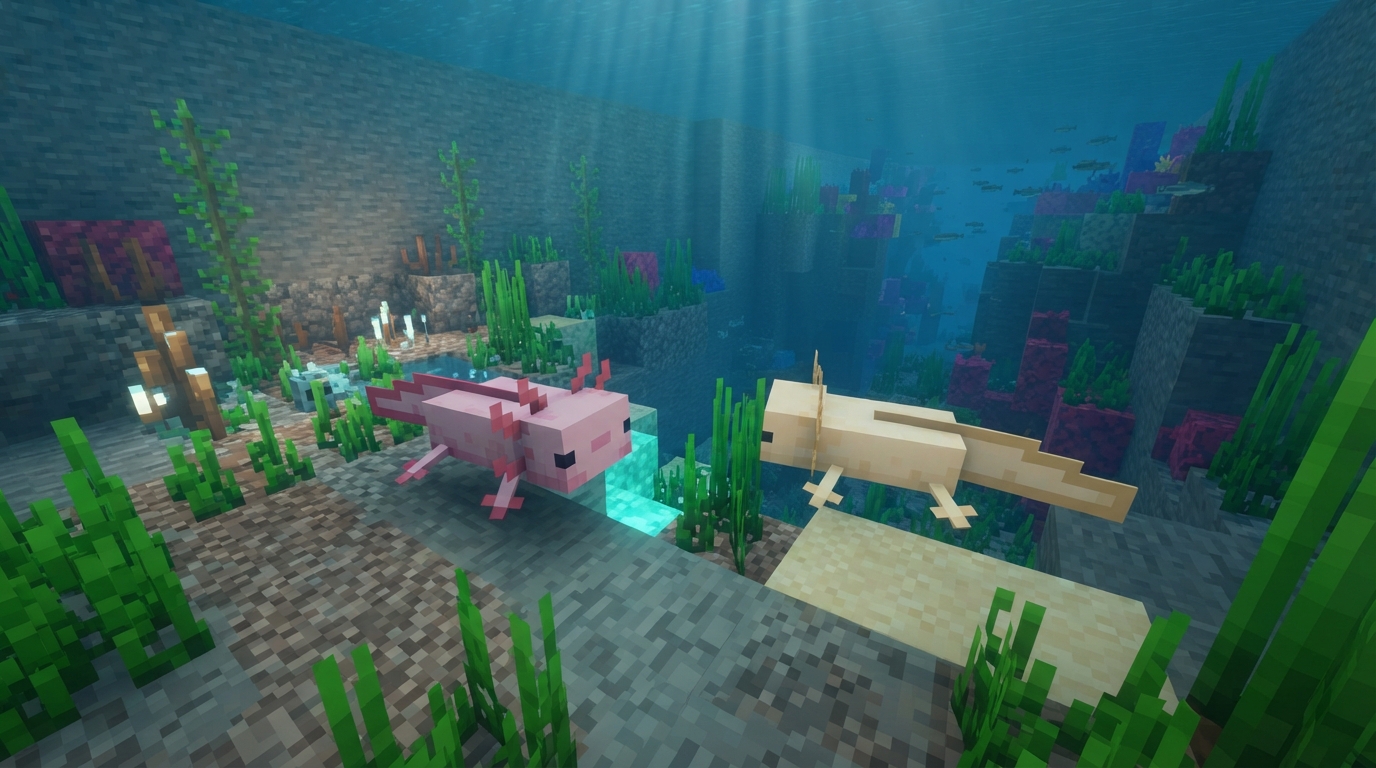
If axolotl breeding doesn’t work, you may have used the wrong item, fed only one adult, or tried before the parents’ cooldown ended. Wrong item: Each adult needs a Bucket of Tropical Fish. Tropical fish by themselves do not trigger breeding. Only one adult was fed: Feed both adult axolotls, using a separate Bucket of Tropical Fish for each one. Parents are on cooldown: The same pair must wait five minutes after breeding in Minecraft Java Edition or one minute in Minecraft Bedrock Edition before breeding again. If a baby appears but is not blue, breeding worked. Blue is a rare baby color, with a 1-in-1,200 chance of appearing. If both axolotls were fed the correct item and their cooldown has ended, a non-blue baby is still a successful result.
Build a Safe Axolotl Home
Choose a spot near your base for an axolotl pool, then finish the enclosure before moving any axolotls. Build a solid floor and walls around the water, and check each corner for gaps. A glass wall lets you watch the axolotls without opening the enclosure.
Fill the pool so the axolotls can stay underwater, then test the enclosure before bringing them over. If water can flow through a gap, close it with a solid block. Keep the entrance closed once the axolotls are inside so they cannot swim out while you work nearby.
Set aside a small, enclosed section of the pool for a new baby. This gives you a clear place to check as it grows, without searching the whole habitat. Keep the section connected to water, and make sure the baby cannot slip through an opening into a cave or another pool.
When the home is ready, carry each axolotl in a water bucket and release it into the enclosure. If your axolotls are already in a temporary pool, build the permanent home beside it first, then move them directly into the finished space. Keep the baby there until it becomes an adult, and leave the walls intact between visits.