
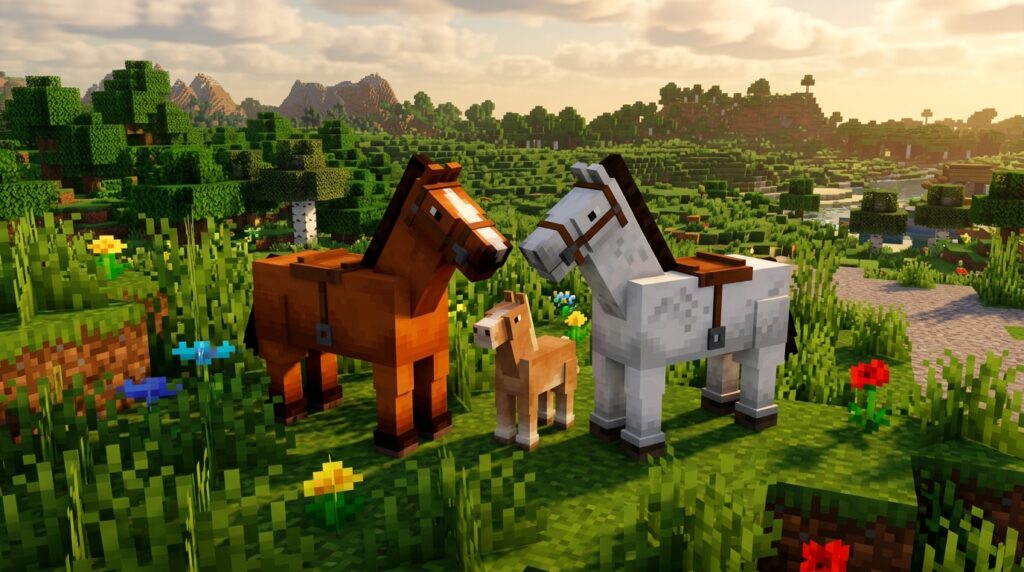
Want faster horses, stronger jumps, or a reliable way to travel across your world? This Minecraft horse breeding guide explains how to tame two adult horses, use golden carrots or golden apples to activate Love Mode, and raise a foal. You will also learn how to breed a horse with a donkey to produce a mule.
Breeding gives you a chance to improve a foal’s speed, jump height, and health, but its traits depend on both parents and random variation. A foal is born untamed, so you must tame it separately after it grows up. These steps work in current vanilla Java and Bedrock Edition.
Key Takeaways
- Tame two adult horses, place them together, and feed each one golden carrot or golden apple to activate Love Mode and produce a foal. Golden carrots are the practical choice for regular breeding because they require fewer resources than golden apples.
- A foal inherits speed, jump strength, and health from both parents with random variation, so strong parents improve the odds but do not guarantee superior offspring. Raise each foal to adulthood, tame it, and test its stats before choosing it for future breeding.
- Improve your stable gradually by breeding, comparing, and keeping the best offspring for traits such as speed, jumping ability, and health. Parents need five minutes between breeding attempts, and foals are born untamed and must be tamed separately after growing up.
- Breeding a horse with a donkey produces a mule that can carry a chest, but adult mules cannot reproduce. Keep horses, donkeys, and mules in secure fenced pens, use saddles and leads for travel, and provide suitable food for healing and growth.
Horse Taming and Breeding Requirements
Adult horses most often spawn in plains and savanna biomes, so search open grasslands for a pair with useful traits. To tame a horse, mount it with an empty hand and keep trying after it throws you off. When hearts appear, the horse is tamed and can use a saddle. You need two tamed adult horses for breeding, so compare their speed, jump height, and health before choosing the parents. The foal can inherit a mix of these traits.
Keep the two tamed horses close together, then feed each parent one golden carrot or one regular golden apple. After both enter Love Mode, they produce a foal. The parents must wait five minutes before they can breed again. Golden carrots are usually the practical choice because they cost less to make than golden apples, especially when you plan to test several parent combinations. The foal is born untamed, so you must tame it separately after it grows up.
Skeleton horses and zombie horses cannot breed, and adult mules cannot breed either. For reliable results, start with healthy adult horses and raise several foals instead of judging only one. A strong foal may inherit a parent’s high speed, jump height, or health, making careful breeding useful when you want a better mount for travel. Horse and donkey breeding can produce a mule, but that mule cannot produce offspring as an adult.
Foal Stats and Horse Inheritance
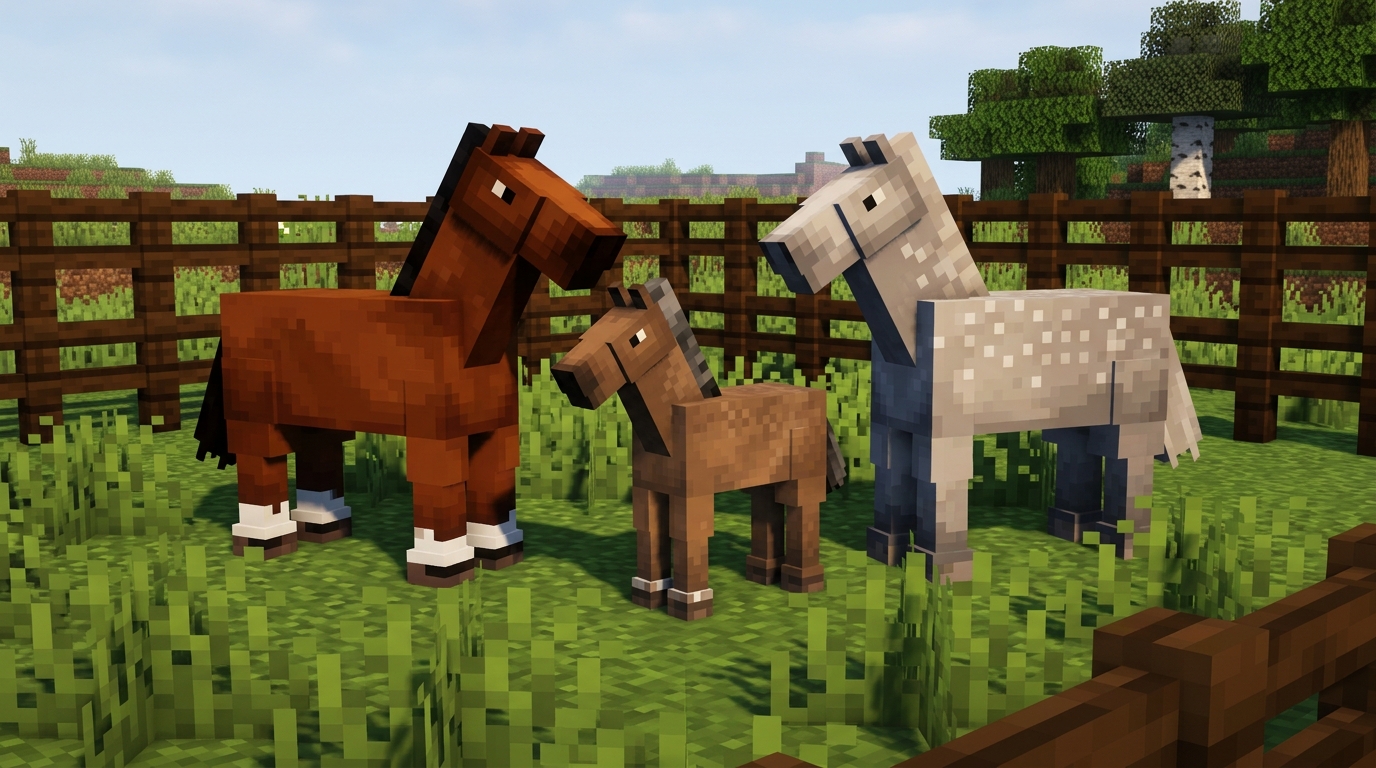
A foal’s health, movement speed, and jump strength come from both parents, with a random value added to the result. The game averages the parents’ stats with this random value, so choosing two strong horses improves your chances but does not guarantee a perfect foal. For example, two horses with excellent speed may still produce a foal that is slightly slower than either parent. Compare parents by taming and riding them, checking their health hearts, timing them across the same flat track, and testing how high they can jump.
Keep the strongest horses for future breeding instead of breeding every adult you find. A horse with high health and jump strength can pair well with a very fast horse, but the foal may inherit a mixed set of traits rather than matching one parent. Check several candidates when possible, since random variation means one foal may be much better than another from the same pair. Horse breeding is a gradual process of selecting, testing, and keeping the best results.
Wait for a foal to grow fully before judging its stats, because a baby horse is not ready for reliable travel tests. Once it becomes an adult, tame it, place a saddle on it, and time it over a marked route to compare movement speed. Use a row of fences or blocks to test jump strength, raising the obstacle one block at a time. Check the horse’s heart bar to compare health. Keep the adult with the best overall combination and use it as a parent for your next breeding attempt.
Breeding Fast, High-Jump Horses
Start by taming the fastest or healthiest adult horses you can find, then test them in a clear area before breeding. For long-distance travel, choose a horse that covers ground quickly and has enough health to survive falls or hostile encounters. For hills, ravines, and fenced paths, keep a horse with a strong jump, even if it is slightly slower. Feed one golden carrot to each parent to activate Love Mode, then keep the best foal and replace the weaker parent in your next breeding pair.
Horse speed, jump height, and health pass to the foal from its parents with some variation, so one breeding rarely gives you a perfect mount. Breed your fastest pair, compare the foal with both parents after it becomes an adult, and repeat the process. If a foal has better speed but poor health, pair it with your healthiest suitable horse. You can also breed a strong jumper with a faster mount to balance both traits. This gradual plan helps you improve your stable without waiting for rare perfect horses.
Golden carrots are the practical choice for regular breeding because each one requires eight gold nuggets instead of eight gold ingots. Keep a small supply of carrots and gold near your stable, and breed only when both parents are ready so you do not waste food. After each generation, mark or separate your best travel horse, high-jump horse, and backup mounts. Remember that every foal is born untamed, so tame it separately after it grows up before judging it on long journeys or difficult terrain.
Donkeys, Mules, and Mount Care
Two adult donkeys fed golden carrots or golden apples produce a donkey foal, while breeding a horse with a donkey creates a mule. Mules combine useful traits from both parents and can carry a chest, making them useful for long trips and early-game storage. However, adult mules cannot reproduce, so you must breed a new horse and donkey whenever you want another one. Tame the parents first by repeatedly mounting them, then tame the foal separately after it grows up.
Keep your mounts in a fenced pen with a gate, and use a saddle to control horses, donkeys, and mules while riding. A lead helps you guide them through villages, forests, and narrow paths, but avoid cliffs, lava, and deep water when moving them because mounts can get stuck or take fall damage. Feed sugar, wheat, apples, golden carrots, or hay bales to heal adult mounts, and use suitable food to speed up a foal’s growth. Store spare saddles and leads nearby so you can move or rescue your animals without leaving them exposed.
When choosing a horse for breeding or travel, test its speed, jump height, and health instead of judging its appearance. A fast horse is best for crossing plains, while a horse with strong jumping ability helps you clear fences, hills, and rough terrain. Higher health makes a mount safer during exploration, especially when crossing caves or uneven ground. Breeding can produce foals with a useful mix of their parents’ traits. Keep your best adults in a secure pen, then compare each grown foal before giving it a saddle.
Breed Horses and Raise Better Foals
Breeding starts with two adult horses that you have tamed by riding them until hearts appear. Place them close together, then feed each one a golden carrot or golden apple to activate Love Mode and create a foal. You can also breed a horse with a donkey to produce a mule, but mules cannot breed with other animals. The foal is born untamed, so you must tame it separately after it grows up.
Pay attention to the foal’s speed, jump height, and health. These traits come from its parents and a random value, so each result can be different. Test the new horse after it becomes an adult, then keep breeding the strongest offspring with your best available parent to improve your chances of raising a useful mount. Golden carrots are usually the practical choice because they are cheaper to make than golden apples. With patience, a carefully bred horse or mule can make exploration, hauling, and early-game travel much easier.