
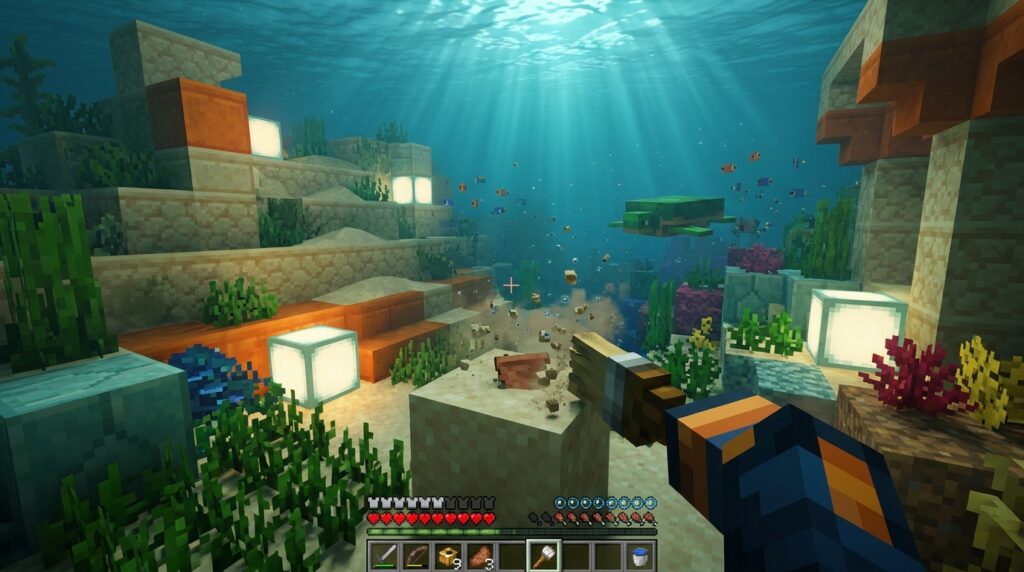
Minecraft ocean ruins are small stone or sandstone buildings on the seafloor. You’ll find two types: cold ruins in normal, cold, and frozen oceans, and warm ruins in lukewarm and warm oceans. Both can hold loot chests and archaeology blocks, so the first step in any ocean ruins guide is figuring out which type you’ve found.
About 70% of ocean ruins are small, and 30% are large. A large ruin has a 90% chance to be surrounded by four to eight small ones. Each suspicious sand or gravel block takes 96 game ticks, or 4.8 seconds, to brush, so you can clear a whole cluster quickly.
Key Takeaways
- Start by checking which type of ocean ruin you found, because warm ruins sit in lukewarm and warm oceans and are built from sandstone, while cold ruins sit in normal, cold, and frozen oceans and are built from stone.
- Brush both types of ruin if you want the full sherd collection, since warm ruin sand can give you the Angler, Shelter, or Snort sherd and cold ruin gravel can give you the Blade, Explorer, Mourner, or Plenty sherd.
- Expect each suspicious sand or gravel block to take 96 game ticks, or 4.8 seconds, to brush, and expect each brushed warm ruin sand block to have a 1-in-15 chance to yield a sniffer egg.
- Brush each suspicious block exactly where the ruin left it, because suspicious sand and gravel drop nothing when broken or moved.
- Watch your air bar while you work on a cluster of ruins guarded by drowned, and swim up to breathe before you start the next block if your air starts to drop.
What Are Ocean Ruins in Minecraft?
Ocean ruins are small stone or sandstone buildings that sit on the seafloor, and the ocean you’re swimming in decides which kind you get. Cold ruins spawn in normal, cold, and frozen oceans and are built mainly from stone. Warm ruins spawn in lukewarm and warm oceans and are built mainly from sandstone, so the blocks on the seabed give you a quick clue.
Most ruins you’ll find are small. Since about 70% of ocean ruins are small and 30% are large, you’ll see small ones far more often. A large ruin has a 90% chance to be surrounded by four to eight small ruins, so a big ruin is often the center of a little cluster. When you spot one, swim around the nearby seafloor before you move on.
Small ruins are compact, so you can check several in one trip. Keep your eyes on the ground around each building, because the suspicious blocks you’ll need later are placed right where the ruin stands.
How Do Warm and Cold Ruins Differ?
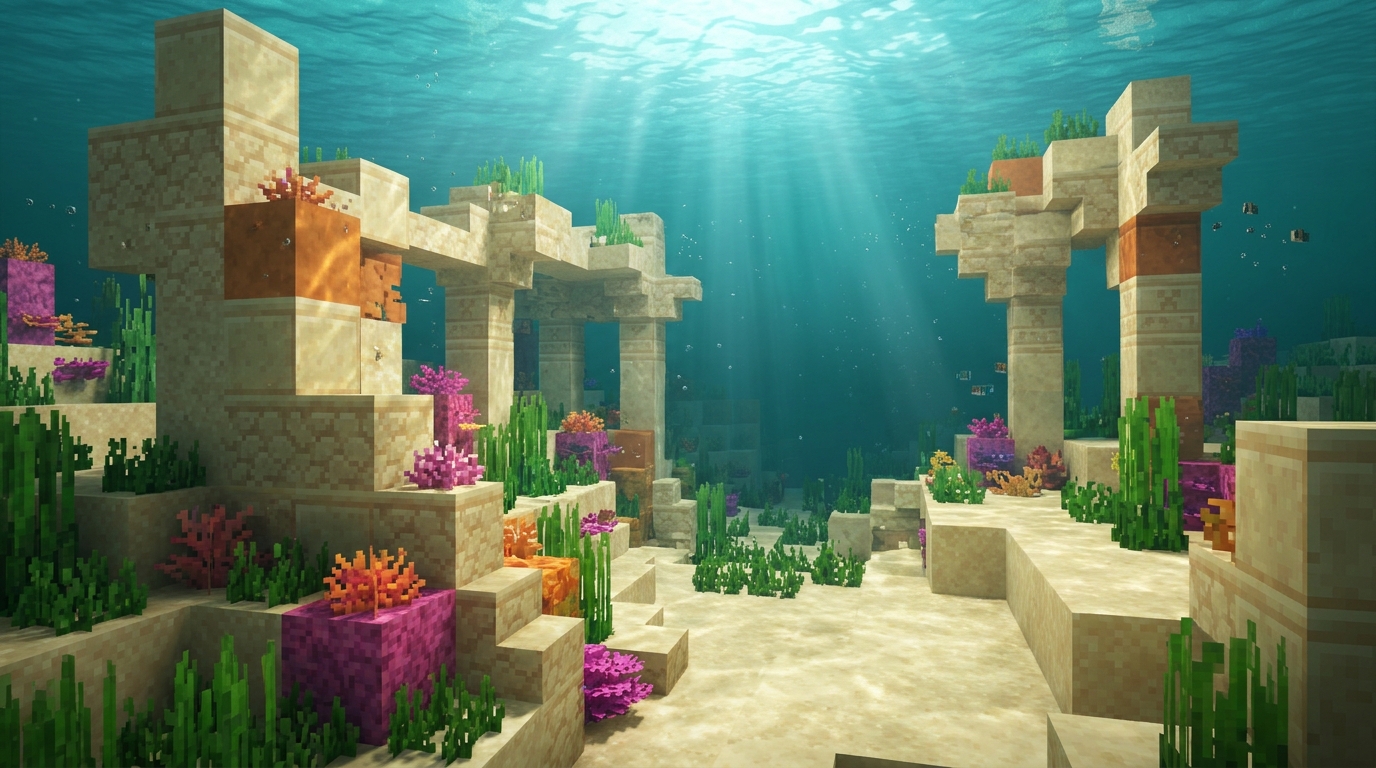
Warm ruins sit in lukewarm and warm oceans and are built from sandstone, while cold ruins sit in normal, cold, and frozen oceans and are built from stone. The quickest way to tell them apart is to look at the ruin’s walls and the blocks lying around its base.
Warm ruins hide suspicious sand, and cold ruins hide suspicious gravel. You need a brush for both, so check your inventory before you swim down.
The loot is where the two types split. Brushing warm-ruin sand can give you the Angler, Shelter, or Snort pottery sherd, and it can rarely give you a sniffer egg, with a 1-in-15 chance per block brushed. Brushing cold-ruin gravel gives you the Blade, Explorer, Mourner, or Plenty sherd instead. Both types can also drop coal, emeralds, wheat, wooden hoes, gold nuggets, and iron axes.
| Warm ruins | Cold ruins | |
|---|---|---|
| Biome | Lukewarm and warm oceans | Normal, cold, and frozen oceans |
| Building material | Sandstone | Stone |
| Suspicious block | Suspicious sand | Suspicious gravel |
| Main loot | Angler, Shelter, and Snort sherds, plus rare sniffer egg | Blade, Explorer, Mourner, and Plenty sherds |
What Loot Do Warm Ocean Ruins Hold?
Warm ruins give you three pottery sherds, Angler, Shelter, and Snort, plus a set of common items and, very rarely, a sniffer egg. Each brushed suspicious sand block can drop any of these, so you might pull a sherd from your first block and a sniffer egg from a block you brush much later.
The common items you can dig up from warm-ruin sand are:
- Coal
- Emeralds
- Wheat
- Wooden hoes
- Gold nuggets
- Iron axes
The sniffer egg is the prize most players are after. Each suspicious sand block you brush has a 1-in-15 chance, or 6.7%, to yield one, so expect to brush many blocks before you find one. Plan on working through a whole cluster of small ruins rather than expecting a quick win.
Keep one rule in mind while you dig. Suspicious sand drops nothing if it’s broken, and it breaks if it falls or gets moved, so brush each block exactly where the ruin left it.
Which Sherds Can Cold Ruins Give You?
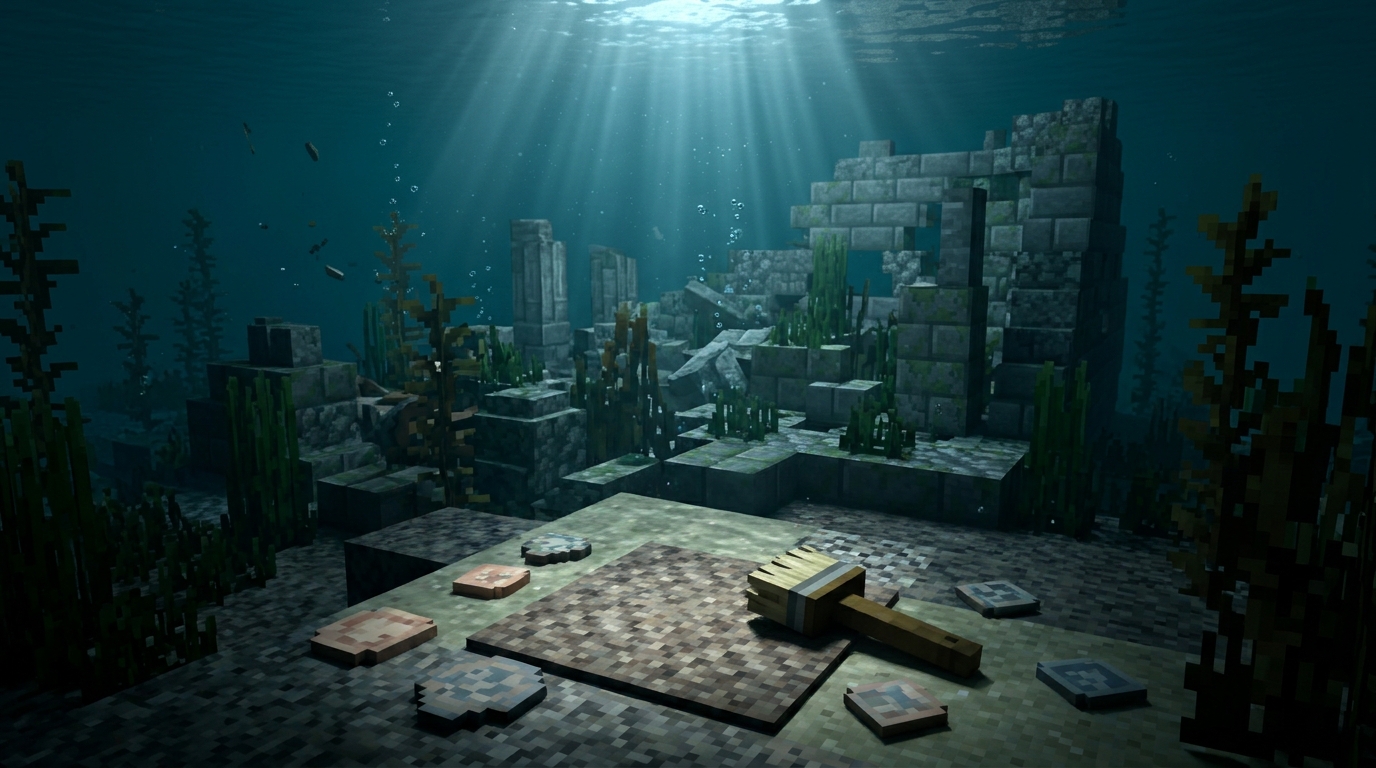
Cold ruins can give you four pottery sherds: Blade, Explorer, Mourner, and Plenty. You dig them out of suspicious gravel, the block type that hides loot inside cold ruins built from stone.
The gravel also drops the same basic supplies you can find in warm ruins: coal, emeralds, wheat, wooden hoes, gold nuggets, and iron axes. That means a cold ruin is worth brushing even if the sherd you want doesn’t appear on your first block.
Cold-ruin sherds are a different set from warm-ruin sherds. Warm sand gives you Angler, Shelter, and Snort instead. If you want the full sherd collection, brush both types of ruin, so keep your brush handy for each one you find.
How Do You Brush Suspicious Blocks Safely?
To brush a suspicious block safely, hold your brush, stand beside the block where the ruin left it, and brush it in place until the loot comes out. Each naturally generated suspicious sand or gravel block takes 96 game ticks, or 4.8 seconds, to brush. Once it finishes, the block turns into ordinary sand or gravel.
Suspicious sand and gravel drop nothing when broken, and they’re destroyed if they fall or get moved. A single mistake can cost you the loot, so treat each block as a one-block job.
Work through each block with these steps:
- Swim down to the suspicious block and confirm it’s still sitting on the ruin’s floor.
- Hold your brush in your main hand and face the block.
- Hold the brush on the block for the full 4.8 seconds.
- Pick up the item that comes out.
- Leave the leftover sand or gravel where it is, and move on to the next block without digging it up.
What Dangers Guard Ocean Ruins?

Ocean ruins can be guarded by drowned, which are zombie-like mobs that rise up from the water and attack you while you work. Before you swim down, plan your route so you know which ruin you’ll visit first and how you’ll get back to the surface. Decide how many suspicious blocks you can brush in one trip, too.
Keep an eye on your air supply while you brush. Each suspicious block takes 4.8 seconds of holding still underwater, and a cluster of small ruins adds up fast. If your air bar starts to drop, stop brushing, swim up, and breathe before you start the next block.
Planning Your First Ruin Dig
Plan your first dig around one large ruin and the small ruins clustered near it. Swim to the big building, check whether its walls are sandstone or stone, and count the suspicious blocks on the seafloor around it so you know what you’re facing.
Before you dive, make sure your brush is in your inventory and your air is full. Start with the suspicious block nearest the ruin’s entrance, then work outward one block at a time. Since each block takes 4.8 seconds to brush, a cluster of small ruins is a manageable first trip.
When you surface, note which pottery sherds you got. If you’re missing a sherd from one type, that tells you whether to look for a warm or cold ruin on your next dive.