
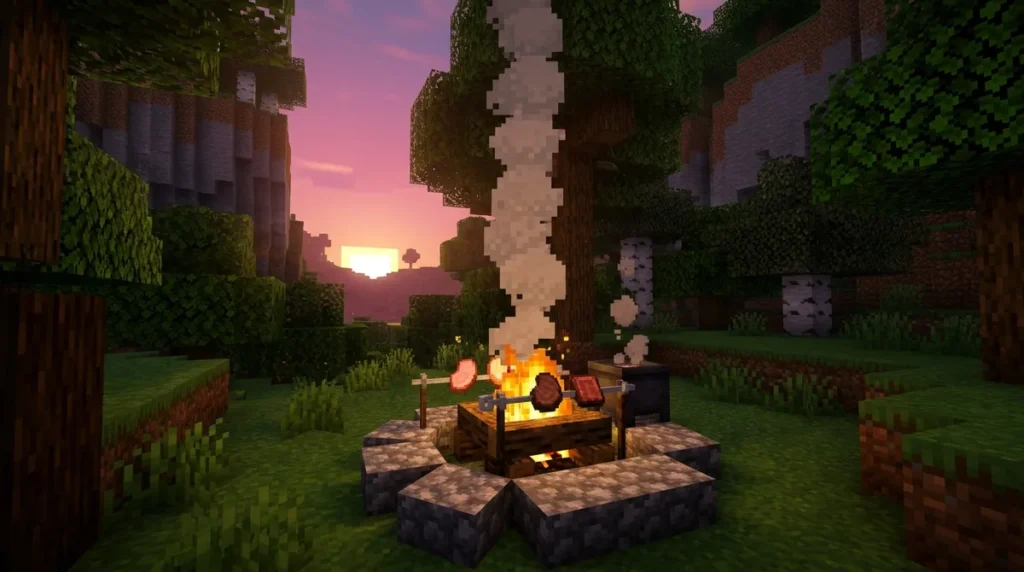
The Minecraft campfire does three main jobs: it cooks food without fuel, gives off light, and sends smoke signals you can spot from across the map. A regular campfire can cook up to four items at once in about 30 seconds, so you can keep a steady food supply going without a furnace. Its smoke rises about 10 blocks high. Place a hay bale underneath, and the column stretches to 24 blocks, making it easy to mark your base from far away.
Campfires also help with builds. They are decorative fireplaces that do not spread fire, so you can light a campsite or a room without worrying about nearby blocks catching. You can place one beneath a beehive to collect honey more safely, or under a note block to play a bass sound.
Key Takeaways
- Save your furnace for bulk cooking at base, because a campfire is built for small batches you cook in the field.
- A regular campfire gives off light level 15, so you can swap one in wherever you would place a torch for light.
- Keep campfires off mob walkways, since a lit campfire deals 1 HP per tick to any mob or villager standing in it.
- A soul campfire repels non-attacking piglins within 8 blocks, so it can help you slip past a crowd near your Nether portal.
Can You Cook Food With a Campfire in Minecraft?
Yes, a campfire cooks food in Minecraft without a furnace, fuel, or any extra setup. Light the campfire, then place raw food on top. Each item starts cooking right away and turns into its cooked version once it finishes, so you can walk off and come back to a meal.
A regular campfire has room for up to four items, and all of them cook at the same time in about 30 seconds. To load it, hold a raw item, right-click the campfire, and repeat for each open spot. Before a long mining trip, load raw beef, mutton, or potatoes into every slot. When you climb back to the surface, your food is ready in one trip instead of several.
Hunting works the same way. Right after a successful hunt, drop your catch on the fire, then clear the nearby area while it cooks. You can have a full set of cooked meat ready before you need to eat again.
A furnace is the better choice when you want to cook large stacks, because it keeps working through big batches as long as it has fuel. A campfire is built for small batches. Use it for a few chops, a handful of potatoes, or a quick meal in the field, and save the furnace for bulk work back at your base.
How Bright Is a Campfire in Minecraft?
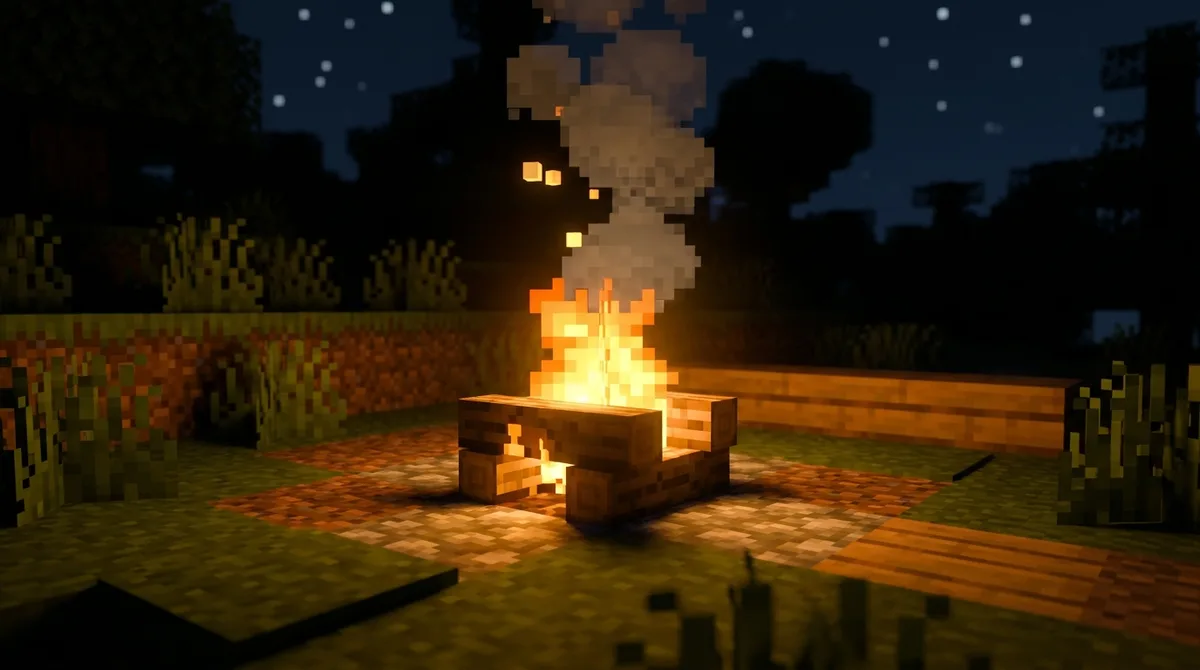
A regular campfire gives off light level 15, enough to light up a small area around your base. Light level is the number that tells the game how bright a block is, and the Minecraft Wiki lists the regular campfire at that top level.
Put a campfire at the entrance of a shelter or a tunnel so you can see where you are going. Set one just inside the door of your wooden hut, or at the mouth of a cave tunnel you dig from the base. The glow reaches the ground ahead, so you can spot steps, drops, and open water before you walk into them.
Because a campfire gives off light level 15, you can use one wherever you would normally place a torch. It works well for lighting a storage room, a hallway, or the entrance to a farm, where you want steady light without digging out a torch line.
Light also matters for mob spawning. Hostile mobs appear on dark ground, so the glow from a campfire keeps the floor near your base from becoming a spawn spot. The real danger is the dark patch just beyond the light. Walk the edge of your lit area and check those shadowy corners, since that is where zombies and skeletons tend to show up.
Sending Smoke Signals With Campfires and Hay Bales
Smoke is the campfire’s signal trick, and it comes in handy when you wander far from home. A regular campfire sends a column of smoke about 10 blocks into the air, which is enough to catch your eye from a nearby hill or across a clearing. Once you remember where you lit it, that thin line becomes a landmark you can steer by.
To make the column taller, place a hay bale directly beneath the campfire. The bale lifts the smoke to about 24 blocks, so it shows above treetops and tall grass. A campfire sitting on a hay bale at your base works as a beacon you can spot from much farther away.
Picture this: you step into a new jungle biome, where the trees block your view in every direction. Before you go deeper to look for ores or loot, glance back and find the smoke on the horizon. If you lose your way later, walk toward that tall column and it will lead you to your base. Write down the coordinates of the campfire too, so you have a backup plan.
Sometimes you want the opposite. Place a trapdoor directly above the campfire to block the smoke, and the column disappears while the fire keeps burning underneath. This gives you a hidden cooking spot, perfect for a quick meal on a long trip when you would rather not signal your position to anyone nearby. Once you are done cooking, bring the smoke signal back by removing the trapdoor.
Collecting Honey Safely Under a Beehive
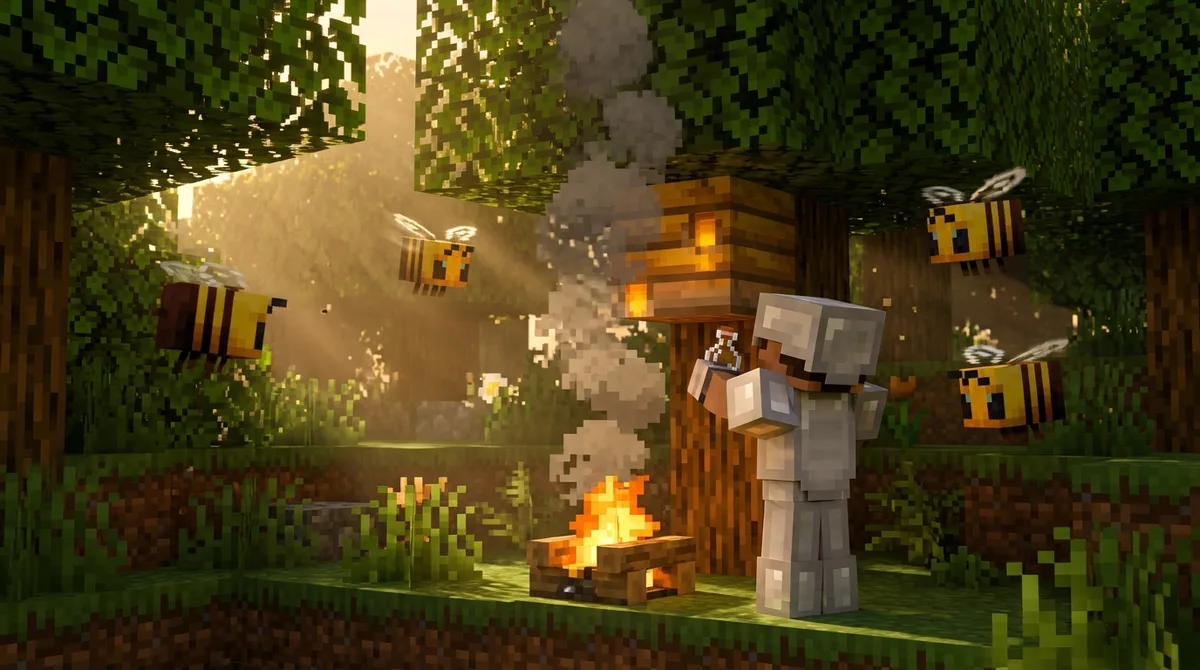
Bees are the tricky part of honey farming, because a disturbed hive will swarm you the moment you touch it. Buzzy Bees live inside beehives and bee nests, so you need a way to keep them calm while you work. A lit campfire solves that problem, and many honey farms use this same setup.
Once you have a hive or nest in your sights, you can collect honey without the stings. Here is how to do it:
- Stand near the beehive or bee nest and place a campfire directly beneath it.
- Light the campfire with flint and steel so its smoke rises up into the hive.
- Wait a moment for the smoke to settle the bees inside.
- Hold a glass bottle and right-click the hive to fill it with honey.
- Or hold shears and right-click the hive to cut out a honeycomb instead.
Keep the campfire burning the whole time you harvest. If it goes out, the bees can wake up and come after you. Stay close to the side of the hive rather than standing directly in its smoke path, so you can work quickly and safely.
Because the bees stay calm, you can take what you need and walk away without a swarm chasing you across the field. Check the hive again later, once it has filled back up, and repeat the process.
What Is the Difference Between a Campfire and a Soul Campfire?
A soul campfire is the blue-flamed cousin of the regular campfire. It gives off less light, repels some piglins, and hurts more when you stand in it. Its light level is 10, compared with 15 for a regular campfire, so it throws a dimmer glow over the same area.
The biggest practical difference is piglin behavior. A lit soul campfire repels non-attacking piglins within an 8-block radius, so it can help you move through a crowd near your Nether portal. It does not repel piglin brutes, so keep your weapon ready if one comes after you.
Damage is the trade-off. A regular campfire deals 1 HP of damage per tick to anything standing in its block, while a soul campfire deals 2 HP per tick. Mind where you place either one, especially in a tight hallway where you might walk right into it. You can read more about campfire damage on the [Minecraft Wiki](https://minecraft.wiki/w/Campfire).
Soul campfires came much later than regular ones. Regular campfires arrived with the Village & Pillage update in 2019, while in Java Edition soul campfires were added during the 1.16 development cycle, first appearing in the 20w15a snapshot. If you play Bedrock Edition, check the version you are running before you plan a soul campfire build.
Decorating Builds and Playing Note Block Bass
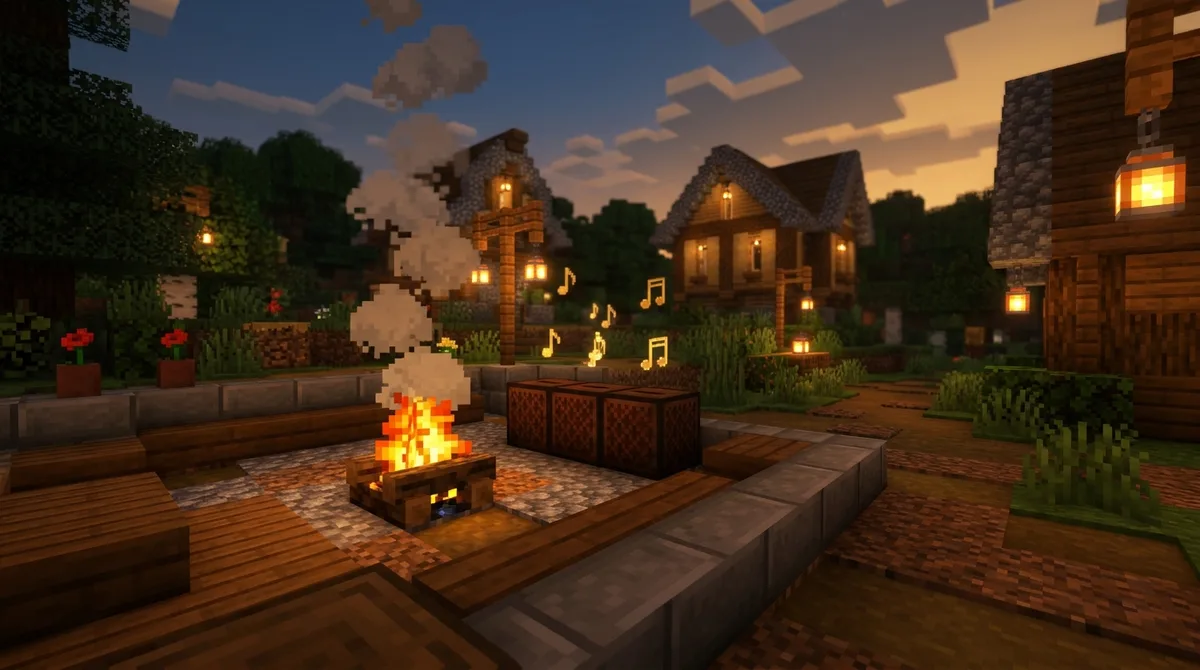
Campfires also make a build feel lived in. Set one in the middle of a clearing, add a hay bale on each side as a seat, and hang a few lanterns from nearby fence posts. Once night falls, the spot glows like a real camp. Campfires arrived in Java Edition 1.14 with the Village & Pillage update, so they suit village-style rooms just as well. Try one beside a farmhouse door or at the edge of a square, and the whole area looks busier.
Campfires can also make music. Place a campfire directly beneath a note block, and the note block plays a bass sound when you hit it. Right-click the note block to change its pitch before you play it.
For a music build, line up several note blocks side by side, each one with its own campfire placed beneath it. Tune each block by right-clicking it until the notes match the tune you want. The low, rumbling sound works well for a tavern, a stage, or a drum-style beat in a village hall.
Does a Campfire Hurt Players and Mobs?
A lit campfire hurts any player, mob, or villager that stands in its block. A regular campfire deals 1 HP of damage per tick to each entity in that space, while a soul campfire deals 2 HP per tick, double the damage. Anything that keeps walking through the fire can lose health quickly.
Think about the route before you place one. Mobs and villagers follow paths, so a campfire sitting in the middle of a walkway can become a trap you did not plan for. During a mob farm run, a zombie or skeleton that wanders into the fire’s block takes damage every tick it stays there. In a village, a villager heading along a narrow lane can get hurt the same way if the fire sits right on its path.
When you build a path, tunnel, or bridge, put the campfire where it is easy to see and avoid. Set it at the edge of the walkway, on a wall beside the route, or at the entrance of a tunnel, rather than in the middle of the floor. A campfire at the start of a bridge gives you a clear marker you can spot as you approach.
Walk the finished route yourself, too. Make sure you can step around the fire without squeezing past it, and leave enough open space that a passing mob or villager has a clear way through. Soul campfires need extra care here, since their double damage can take a big bite out of your health before you notice.
Placing Your First Campfire for Survival and Builds
Start with one campfire at your base’s front door. A regular campfire gives you light and a quick cooking spot in the same block. Carry a few raw potatoes or chops, then load all four slots to see how the setup works in practice.
Next, add a hay bale under the fire and walk out to a nearby hill or clearing. Look back at your base and check whether the smoke column stands out against the treetops. If it blends in, move the campfire to a higher spot or stack the bale higher on the ground.
If you are building a village-style path or a tunnel, put the campfire on the edge of the walkway, not in the middle. Walk the route once and make sure you can step around it without squeezing past. Then place a second campfire beneath a note block and right-click it to hear the bass tone for your build.
Finally, write down the coordinates of your main campfire on a sign or in a notebook. That gives you a landmark when you wander into a new biome. Keep a trapdoor in your inventory too, so you can hide the smoke when you need a quiet meal.