
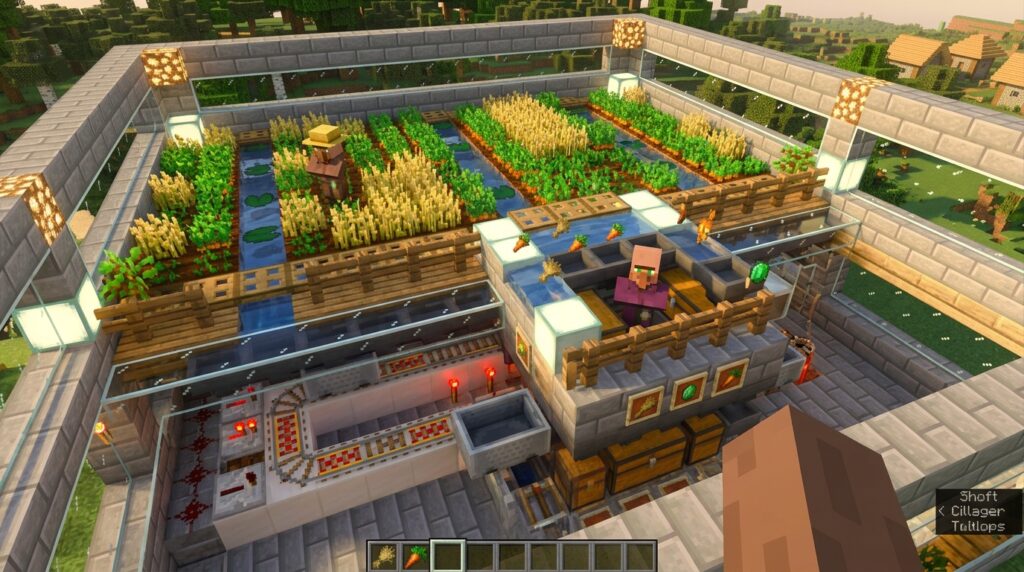
Tired of spending your precious survival hours manually replanting carrots and potatoes just to stay fed? Building an automatic villager crop farm is the ultimate way to get infinite food and emeralds while you focus on more exciting projects like raiding trial chambers. By using a farmer villager’s natural instinct to share food with their hungry friends, you can trick the game into delivering stacks of crops directly into your storage chests.
Recent updates have made these systems even more powerful, especially when you pair them with a simple Nether portal chunk loader to keep the farm running while you are away. All you need is a few hoppers, a hopper minecart, and a villager with an empty inventory to start your automated empire. This setup turns your base into a high-efficiency resource hub that works for you every single day.
Key Takeaways
- Leverage the natural AI of farmer villagers to automate crop harvesting by placing a second ‘hungry’ villager nearby to act as a target for food sharing.
- Utilize hopper minecarts positioned beneath the meeting point of the two villagers to efficiently collect tossed items through solid blocks.
- Implement a Nether portal chunk loader to ensure the farm remains active and productive even when you are exploring distant parts of the world.
- Optimize farm efficiency and safety by using glass walls for light, centralizing workstations under slabs to prevent crop trampling, and protecting villagers from lightning strikes.
Mechanics Of Farmer Villager Inventory And Sharing
The secret to this farm lies in the social nature of villagers and their natural instinct to help one another. Farmer villagers have a unique hidden inventory that they fill by harvesting crops like carrots, potatoes, or wheat from the tilled soil. Once their pockets are full, they look for a hungry neighbor to share their bounty with, which usually happens during their scheduled gossip time. By placing a second villager in a small pod nearby, you create a permanent target for the farmer to throw food toward. Because the farmer sees a friend in need, he will constantly try to toss items over, creating a loop of endless food production without you ever having to lift a tool.
To make this system work for you, you need to place a collection point right where the food is thrown. Since villagers cannot actually reach each other through a wall or a fence, the items they throw will simply drop to the ground. This is where you place a hopper minecart directly underneath the block where the villagers meet. Hopper minecarts are much faster than standard hoppers and can pull items through solid blocks, ensuring that not a single carrot or potato goes to waste. This simple trick turns a social interaction into a high-speed delivery system for your storage chests.
- Use a villager with an empty inventory to ensure they only pick up the specific crop you want to farm.
- Place a trapdoor or a fence between the two villagers so they can see each other but cannot occupy the same space.
- Ensure the hungry villager has no food in their own inventory so they continue to act as a valid target for sharing.
- Keep the farm well-lit with torches or glowstone to prevent hostile mobs from spawning and to keep the crops growing through the night.
Setting up this inventory mechanic is one of the best ways to move away from manual labor and into the mid-game. You can expand this design by stacking multiple layers of farms on top of each other or by placing several farmer pods around a single central collection villager. This setup provides you with a massive surplus of items that you can use for eating, breeding more villagers, or trading for emeralds. It is a low-cost solution that uses the villagers’ natural AI to do all the hard work while you focus on building and exploring your world.
Essential Materials For Your First Automatic Farm Module
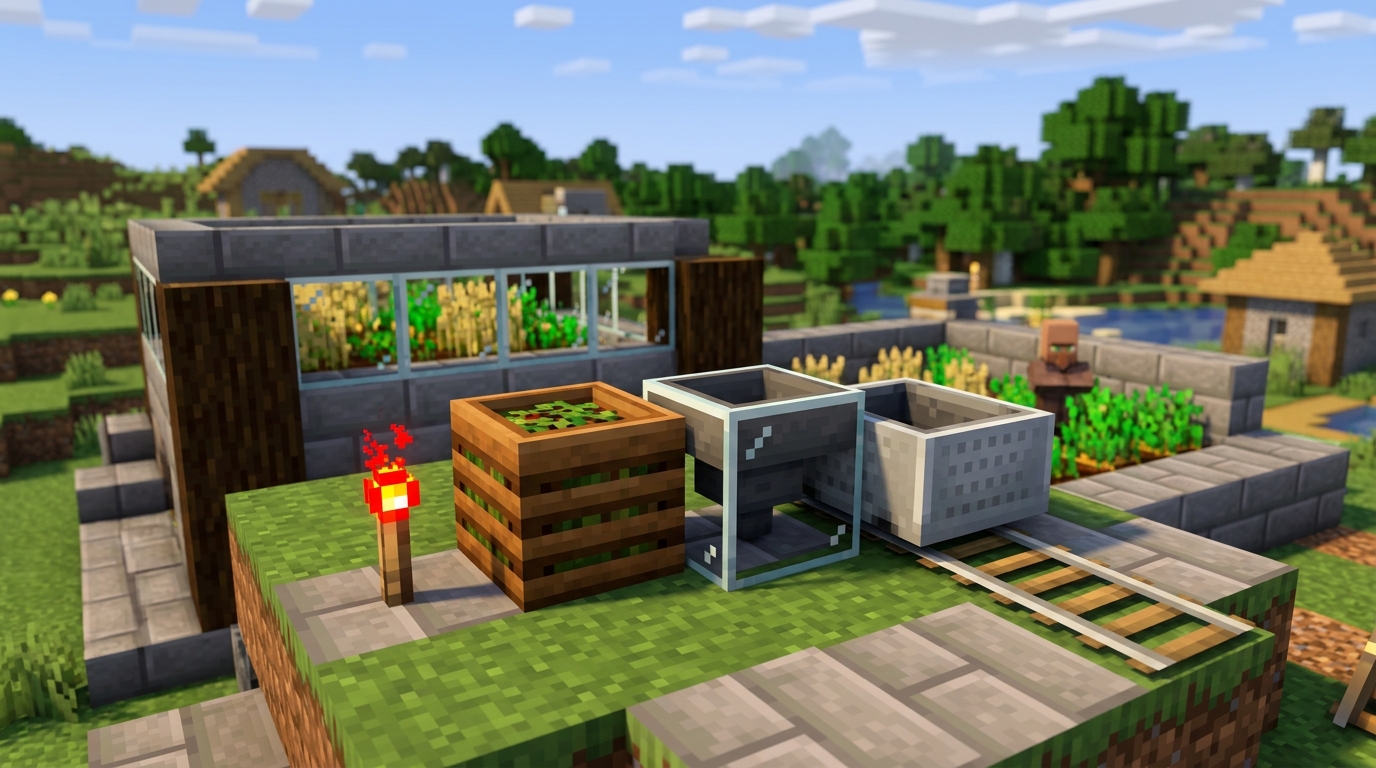
Building your first automatic farm is an exciting milestone because it marks the end of manual harvesting and the beginning of infinite resources. You do not need expensive redstone components like observers or pistons to get this running in the early game. Instead, you only need a few basic building blocks and two specific villagers to act as your workers. Since this design relies on mob behavior rather than complex wiring, it is one of the most budget-friendly projects you can start in a new world.
To get your module up and running, you should have these essential items ready in your inventory:
- A Composter to give your worker the Farmer profession.
- A Hoe and plenty of seeds (carrots or potatoes work best) to prep the land.
- Trapdoors to prevent your villagers from jumping on the crops or escaping their cells.
- A Hopper or Hopper Minecart to catch the food items as they are thrown.
- Glass blocks so you can keep an eye on your workers without blocking their light.
The most important material for this farm is actually the villagers themselves, specifically one hungry villager who will never get fed. You will place this villager in a small central pod, surrounded by hoppers that intercept the food your farmer tries to share with them. It is best to use a villager with an empty inventory, such as one fresh from a villager breeder, so they can immediately start picking up the crops you want to farm. Once you have these pieces in place, your farm will produce stacks of food while you focus on exploring or building.
Optimizing Crop Yields With Chunk Loaders And Workstations
To keep your automatic farm running while you explore distant biomes or work on other projects, you need to use a chunk loader. These simple machines usually involve throwing an item through a Nether portal and back again to keep Minecraft farms running in that specific area. Without a chunk loader, your farmer villager will literally freeze in time once you walk too far away, which stops your food production completely. Setting this up ensures that your chests continue to fill with carrots or potatoes even when you are thousands of blocks away from your base. It is the best way to turn a basic farm into a truly infinite resource generator that works for you every single second you are logged into your world.
Keeping your villager focused is just as important as keeping the chunks loaded, so you must manage their workstation and pathfinding carefully. You should always place the farmer’s compost bin in a central, easy-to-reach spot and surround it with a top slab to prevent the villager from jumping on top of it and trampling your crops. If the villager can easily reach their job block, they will stay happy and continue working through their daily schedule without getting stuck or distracted by nearby walls. You can further optimize their focus by following these simple placement tips:
- Place a light source like a torch or glowstone directly above the compost bin to prevent hostile mobs from spawning inside your farm.
- Build a small roof or glass ceiling over the farm area to protect your hardworking villager from lightning strikes and turning into a witch.
- Ensure the hungry villager in the collection cell has no workstation of their own, which keeps them standing still and ready to receive food tosses.
Inventory management is the final secret to a high-yield farm, especially when you are first starting out. You want to make sure your farmer starts with a completely empty inventory so they do not accidentally fill up on seeds or items you do not want. You can easily get a fresh worker by curing a zombie villager or breeding a new one and giving them their first job right inside the farm walls. Once their inventory is full of the specific crop you are growing, every extra item they harvest will be thrown toward their friend and caught by your hopper minecarts. This simple setup eliminates the need for complex redstone clocks and provides you with all the trading materials you need for emeralds.
Enjoy Your Endless Supply of Crops
By putting your farmer villagers to work, you have successfully unlocked a constant stream of resources without the need for complex redstone wiring or manual harvesting. This farm is a great addition for your early survival world because it provides you with endless stacks of carrots, potatoes, or bread with very little effort. You can now spend your time exploring or raiding trial chambers instead of clicking on dirt blocks to replant your seeds. Your new automated helpers will keep your storage chests full around the clock while you focus on more exciting projects.
Having a steady supply of crops makes trading with other villagers much faster and more rewarding. You can take your massive harvests to a fletcher for emeralds or a farmer villager for golden carrots, which are the best food source in the game. These emeralds allow you to buy powerful enchanted books, diamond gear, and rare building materials without ever having to go mining. This simple build transforms your experience by turning mob labor into a reliable engine for wealth and survival.
As you expand your base, remember that you can easily scale this design by adding more layers or different crop types to meet your needs. If you find yourself with too many items, consider adding a simple composter system to turn the excess into bone meal for your flower gardens. This farm is one of the most efficient ways to use game mechanics to your advantage, especially since it requires so few materials to build. Once you have mastered this, you can build a simple villager trading hall to turn those crops into the best gear in the game. To ensure your hard work isn’t undone by a storm, you should also learn about lightning rod placement to keep your wooden structures and villagers safe. Enjoy the freedom of never having to worry about your hunger bar or trading supplies ever again.