
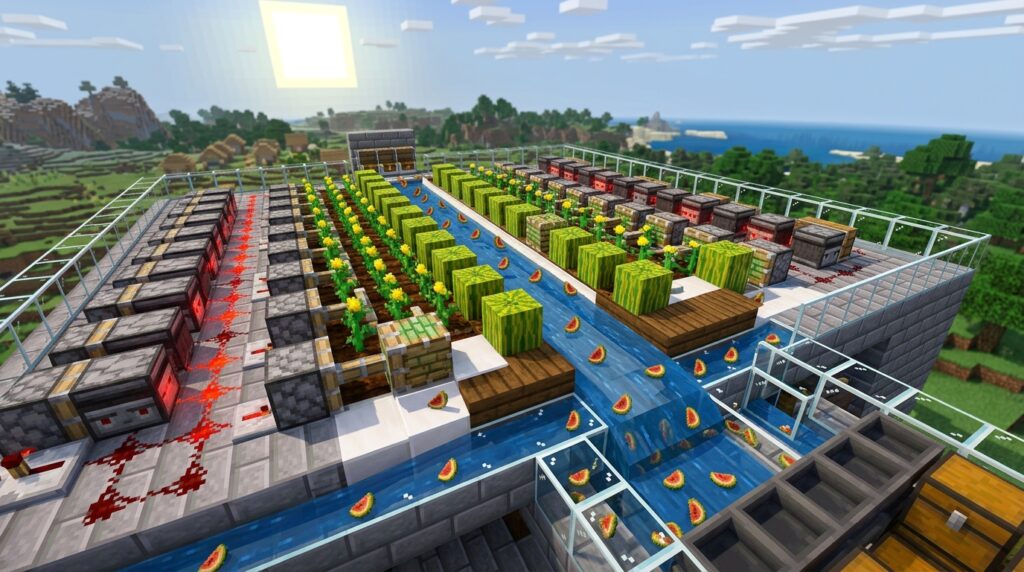
If you want to level up your survival world, building an automatic melon farm for your bedrock edition world is the best way to get rich quick. You can trade stacks of melon slices to your village farmers for emeralds or use them as a never-ending food source while you explore. Modern designs are now so efficient that you can harvest over 5,000 items every hour without ever lifting a diamond axe.
These farms work by using observers to watch your stems and pistons to instantly smash the fruit as soon as it grows. A hopper minecart zooms underneath the dirt to pick up every single slice, so nothing ever goes to waste. Whether you are playing on a phone, console, or PC, these compact and lag-free builds will keep your chests overflowing with resources while you focus on your next big project.
Key Takeaways
- Utilize observers to monitor melon stems and trigger standard pistons for an instant, lag-free harvest that yields over 5,000 items per hour.
- Implement a hopper minecart on a rail system directly beneath the dirt blocks to collect items through solid surfaces and ensure zero resource loss.
- Scale production vertically using modular designs and integrate the Auto-Crafter block to compress slices into full blocks for efficient storage and transport.
- Convert massive melon yields into a sustainable emerald factory by trading stacks of slices with village farmers for high-tier gear and enchantments.
Essential Redstone Components For Bedrock Melon Harvesting
To get your farm started, you will need a few key redstone components that work together to detect and harvest your crops. Observers are the brains of the operation because they can sense exactly when a melon grows by watching the movement of the stem. You should place these observers facing the stem so they send a quick signal the moment a new melon appears. This specific redstone logic is much more reliable than using timers because it only triggers when there is actually something to harvest. Using this method saves you from unnecessary lag and ensures your farm runs smoothly on your console or mobile device.
Once the observer detects growth, you need pistons to act as the muscles of your build. Standard pistons are perfect for this job because they can instantly break the melon into slices when they receive that redstone signal. You will want to position your pistons directly next to the dirt block where the melon spawns so they can push and break it immediately. This setup is great for players because it creates a simple loop that provides a steady flow of food or items for villager trading. It is a much more efficient way to gather resources than harvesting by hand every time you need a snack.
Collection is the final piece of the puzzle, and a hopper minecart is the best tool for the job. Since melon slices can get stuck on top of the dirt, you should run a minecart on a rail line directly underneath your farm. Hopper minecarts are special because they can pull items through solid blocks, making sure you never lose a single slice. You can then direct these items into a chest to build up a massive supply of resources for your world. This simple collection system allows you to walk away and focus on other adventures while your farm does all the work.
Step By Step Observer And Piston Placement Logic

To get your farm running, you need to place your pistons and observers in a specific checkerboard pattern. Start by tilling a row of dirt and planting your melon seeds on every other block, leaving a gap for the melon to actually grow. Place a regular piston facing downward or sideways directly over the empty dirt blocks where the fruit will appear. This ensures that as soon as a melon pops into existence, the piston is ready to smash it into collectable slices. Since Bedrock Edition mechanics are unique, this physical layout prevents the redstone from getting stuck in an infinite loop.
Setting up the detection logic is the next step to make the farm fully automatic. Position an observer so it is looking directly at the melon stem rather than the space where the fruit grows. When the stem bends to produce a melon, the observer detects this change and sends a quick pulse to the piston next to it. You can connect the observer to the piston by placing a solid block behind the observer and a piece of redstone dust on top of the piston. This simple circuit creates an instant harvest every time a new melon appears.
Once your first module is working, you can easily expand the farm by repeating this pattern in a long row. Make sure you have a hopper minecart running on rails underneath the dirt blocks to pick up the slices that fall through the floor. This setup is perfect for console players who want a reliable source of melon slices for food or for trading with village farmers for emeralds. By using this specific observer and piston logic, you avoid the lag and glitches that sometimes happen with more complicated redstone builds. If you find yourself with too many seeds after planting, you can use the best Minecraft compost bin recipes to turn that organic waste into bone meal to speed up your initial crop growth.
Efficient Collection Systems Using Hopper Minecarts And Rails
To get every single melon slice into your storage chests, you need a collection system that works through solid blocks. Since melons break into multiple slices when hit by a piston, they often scatter across the dirt where they grew. A hopper minecart is the perfect solution for this because it can pick up items through a full block of dirt or grass. You will want to dig out a space exactly one block beneath your farm rows to lay down your tracks. Using a minecart ensures that no items are left behind to despawn, which maximizes your farm’s efficiency for villager trading.
Setting up the rail line is simple and only requires a few basic redstone components like powered rails and redstone torches. You should create a long loop or a back and forth track that covers every spot where a melon could land. Place a powered rail every eight blocks to keep the minecart moving at a consistent speed so it never gets stuck. At one end of the track, set up a hopper pointing into a large chest with a regular rail on top. This allows the minecart to pass over and automatically crafting a storage system that handles high volumes of items efficiently.
This method is much more effective than using water streams because it saves space and works perfectly in the Bedrock Edition engine. You can even stack multiple layers of your farm on top of each other and have a single minecart handle the collection for the bottom row. By using this setup, you turn your melon farm into a fully hands-off resource generator. You will soon have stacks of melon slices ready to trade with farmers for emeralds or to use as a quick snack. This collection style is a must-have for any player looking to master your Minecraft world through automation.
Maximizing Your Yields With Auto Crafters And Stacking
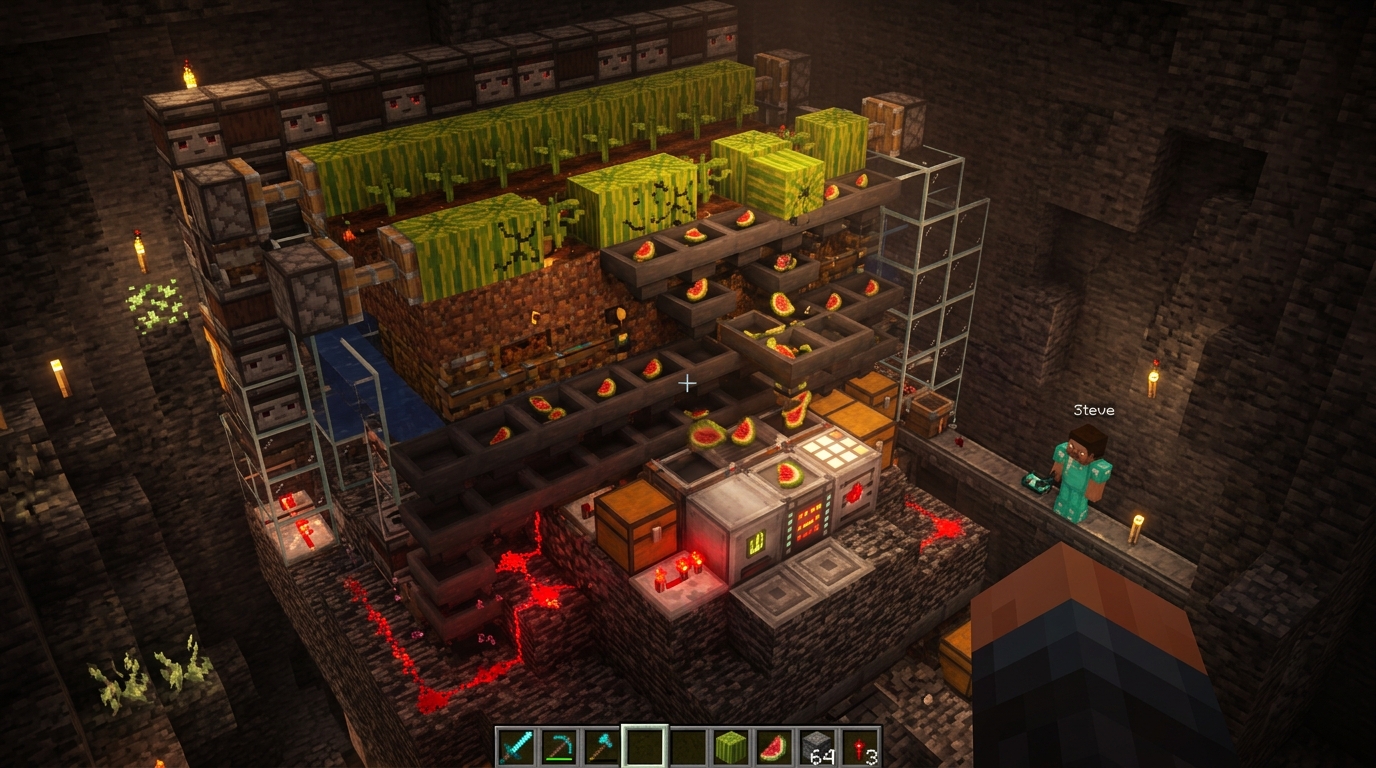
The new Auto-Crafter block changes everything for your melon farm by solving the problem of inventory management. Instead of filling up your chests with thousands of individual melon slices, you can now feed those items directly into a crafter to turn them into full melon blocks. You simply need to set the internal grid of the Auto-Crafter to fill all nine slots, and it will automatically compress your harvest as it comes in. This setup makes it much easier to transport your goods to a nearby village for trading. By mastering automatic crafter redstone setups, you save massive amounts of storage space while keeping your farm running smoothly.
Scaling up your production is easy when you use a modular design that stacks vertically. You can build multiple layers of melon stems and pistons on top of each other, using a single hopper minecart track at the bottom to collect everything. Each module uses observers to watch for growth, which then triggers a piston to break the fruit instantly. When you stack these units high enough, you can easily reach a massive output of 5,000 items per hour. This high efficiency ensures you always have plenty of resources for health potions or emerald trades with your local villagers.
Efficiency in Bedrock Edition relies on using the right redstone logic to prevent lag while maximizing growth. You should place your observers directly above the stems or next to the growth spot to ensure every new melon is harvested the moment it appears. Since these designs are compact, you can fit dozens of modules into a small area near your base. This constant stream of items happens in the background while you focus on other adventures in your world. Building your farm this way turns a simple food source into a powerful, fully automated emerald factory.
Harvest More Melons Effortlessly with Redstone
Building an automatic melon farm is one of the smartest moves you can make to master your Bedrock Edition world. By using observers to watch the stems and pistons to harvest the fruit, you bypass the need for manual farming entirely. This redstone logic is unique compared to simple sugarcane towers, as it specifically reacts to the block update of the melon appearing. Once your hopper minecart is buzzing along underneath the dirt, you can walk away and let the resources pile up. It is a reliable way to ensure you always have plenty of food for your adventures.
Your new farm is a literal gold mine when it comes to leveling up your villager trading hall. Farmers will happily trade your harvested melon slices for emeralds, which you can then use to buy enchanted books and diamond gear. Since these designs are easily stackable, you can expand your farm vertically to reach production rates of thousands of items per hour. This constant stream of emeralds transforms your gameplay from a struggle for resources into a wealthy empire. You now have everything you need to build a simple villager trading hall to keep your chests overflowing and your trading profits soaring.
Frequently Asked Questions
1. How do you get emeralds from your automatic melon farm?
You can take your stacks of melon slices to a nearby village and trade them with farmer villagers. This is one of the fastest ways to get rich in survival mode because the farm produces items while you do other things.
2. Why are observers better than timers for this farm?
Observers are much more efficient because they only trigger the pistons when a melon actually grows. This prevents constant redstone noise and reduces lag on your mobile device or console while ensuring every melon is harvested instantly.
3. Will this farm work on my phone or Xbox?
Yes, this specific design is built for the Bedrock edition of Minecraft, which includes mobile devices, consoles, and Windows 10. It uses redstone logic that is stable across all these platforms so your farm won’t break during gameplay.
4. How does the farm collect the melon slices automatically?
A hopper minecart runs on a rail system directly underneath the dirt blocks where your melons grow. It can pull items through solid blocks and drop them into a storage chest so you never have to pick up a single slice yourself.
5. Do I need sticky pistons for the harvesting mechanism?
No, you only need standard pistons to break the melons into slices. When the observer sends a signal, the standard piston pushes forward to smash the fruit and then retracts, making it a very budget-friendly build for early game players.
6. How many items can I expect to harvest in an hour?
A well-built modern design can produce over 5,000 items every hour. This massive output ensures your chests stay full of food for exploring or plenty of resources for trading with your local villagers.