
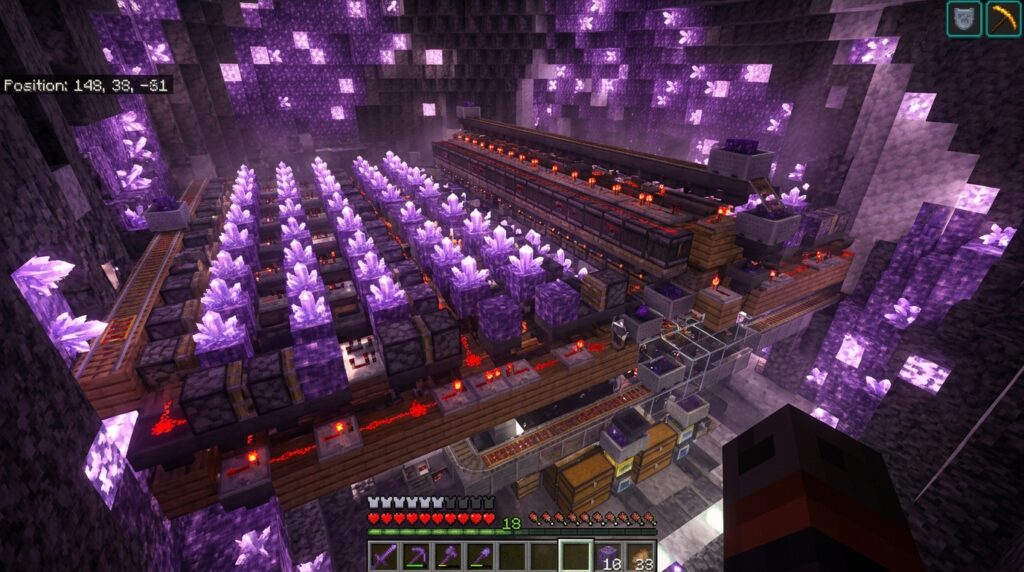
Finding a geode deep underground is always exciting, but turning those purple crystals into a steady supply of shards requires a clever automatic amethyst farm. Since you cannot move Budding Amethyst blocks with pistons or pick them up with Silk Touch, you have to build your machine right where you found it. These farms use observers and redstone to watch for the final growth stage, ensuring you never accidentally break a small bud before it is ready.
While using a Fortune III pickaxe by hand gives you more shards, a fully automated system saves you hours of tedious mining. You can simply walk away or work on other projects while your pistons pop the clusters into a hopper minecart system. It is the perfect way to get all the tinted glass and spyglasses you need without ever lifting a finger.
Key Takeaways
- Build your farm exactly where the geode is found, as Budding Amethyst blocks cannot be moved by pistons or collected with Silk Touch.
- Clear a minimum two-block gap around budding blocks to accommodate pistons and redstone while protecting the crystal source from accidental destruction.
- Choose between observer-based detection for maximum efficiency or a redstone clock for a simpler, lag-friendly automation method.
- Implement a hopper minecart or Allay collection system to ensure no shards are lost, compensating for the lower yield compared to manual Fortune III mining.
Locating And Preparing Your Budding Amethyst Blocks
Finding a geode is your first step toward a steady supply of tinted glass, and you can usually spot them by looking for smooth basalt or calcite while mining deep underground. Once you step inside the purple crystal cavern, you need to identify the Budding Amethyst blocks, which are the ones with a distinct cross pattern on their faces. You cannot move these blocks with pistons or pick them up with Silk Touch, so your farm must be built exactly where you find them. Take a moment to mark these specific blocks with torches so you do not accidentally break them while you are working. These are the only blocks that grow crystals, making them the most valuable part of the entire geode.
After you have located your budding blocks, you need to clear away the surrounding layers of tuff and calcite to make room for your redstone components. Use a pickaxe to carefully remove the white and grey stone layers until you have a wide open space around the purple cluster. You should create at least a two block gap around each budding block to ensure there is enough room for pistons and observers. This extra space is vital because your redstone wiring will need to fit behind the machinery without interfering with the growth of the amethyst. A clean workspace makes it much easier to align your pistons perfectly with the clusters.
Keep in mind that you should only break the regular amethyst blocks and leave the budding ones untouched to avoid losing your crystal source. If you accidentally break a budding block, it is gone forever and you will have to find a new geode to start over. Clearing out the entire interior of the geode gives you a better view of the layout and helps you plan the most efficient path for your collection system. You can even use the discarded calcite as a beautiful building block for your base while you wait for your farm to start producing shards. Once the area is hollowed out, you are ready to begin placing the pistons that will do the harvesting for you.
Choosing Between Piston Timing And Observer Detection
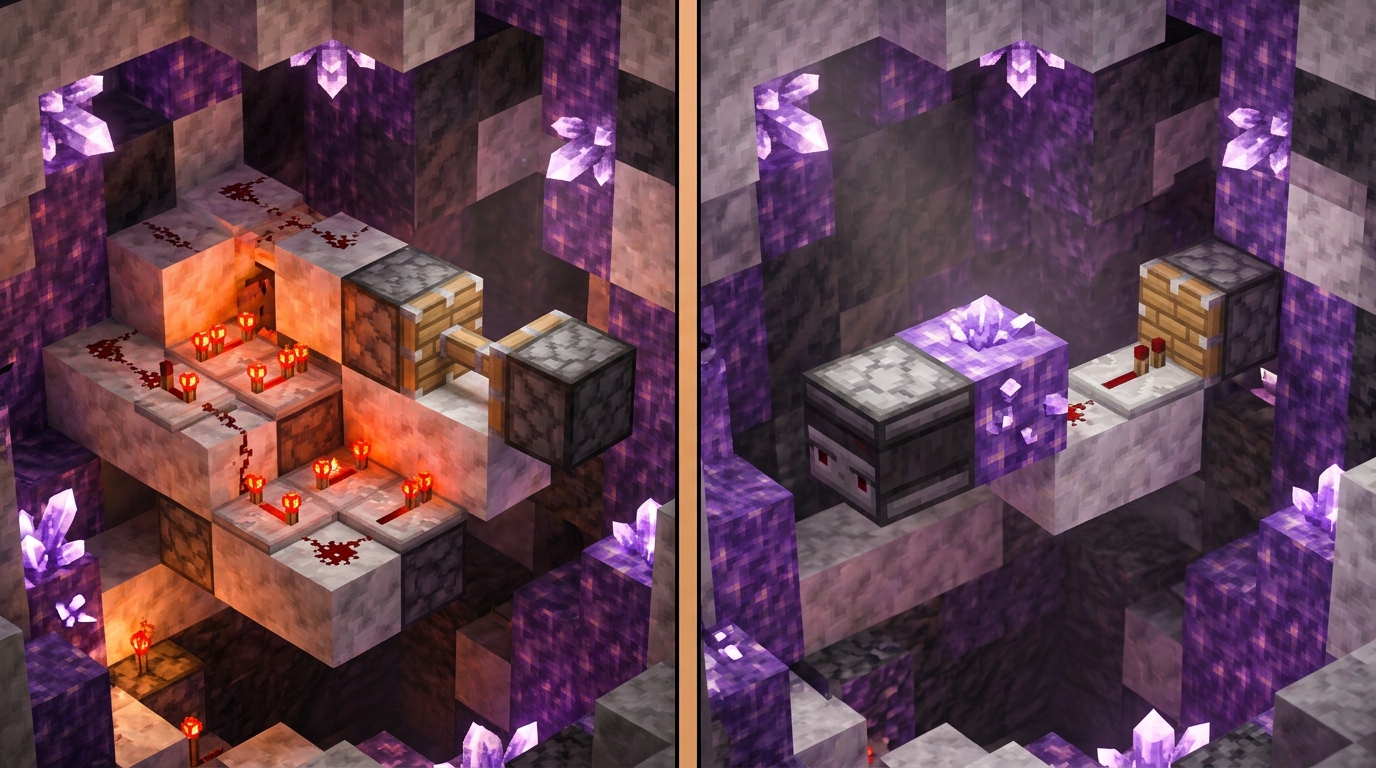
When you are setting up your farm inside a geode, you have to decide how to tell your pistons when to fire. Using a long cycle redstone clock is a great choice if you want a simple build that stays tucked away behind the walls. Since amethyst grows slowly based on random ticks, you can set a hopper clock to trigger every few hours to harvest whatever has reached full size. This method is very lag-friendly because the redstone only moves once in a while. You might occasionally fire a piston at an empty space or a small bud, but it is a reliable way to get a steady supply of shards for your tinted glass projects.
If you want a more high-tech approach, you can use observers to watch the amethyst buds as they grow. Observers detect the block updates when a bud moves from a large size to a full cluster, sending a signal to the piston immediately. This ensures that you harvest the shards the second they are ready, which maximizes your farm efficiency over time. The downside is that observers can sometimes be tricky to place in tight geode spaces without blocking other growth spots. You also have to be careful that the piston movement does not trigger the observer again and create an infinite loop.
Deciding between these two comes down to how much space you have and how much redstone you want to craft. A clock is wonderful for a set and forget style where you just want enough shards for a few spyglasses without any hassle. On the other hand, observer detection is perfect if you are a builder who needs thousands of blocks of tinted glass for a massive base. Both methods work well, but remember that because you lose the Fortune III bonus with pistons, speed and consistency are your best friends. Choose the timing method that fits your redstone skill level and the shape of the geode you found.
Maximizing Shard Yields With Allay Collection Systems
Setting up an automatic piston system is the most convenient way to gather amethyst, but you have to plan for the lower yield. Since pistons only drop two shards per cluster compared to the massive amounts you get with a Fortune III pickaxe, every single shard becomes precious for your tinted glass projects. To make sure you do not lose any items to despawning, you need a collection system that covers every nook and cranny of the geode. Allays are the perfect helpers for this job because they can fly into tight spaces where hopper minecarts might struggle to reach. Simply give one Allay an amethyst shard, and it will tirelessly collect every piece dropped by your flying machine or piston wall. You can even use the allay duplication method to grow your team of helpers quickly.
If you prefer a more traditional redstone approach, a hopper minecart track running underneath your budding amethyst blocks is a solid choice. These minecarts are powerful enough to pull items through solid blocks, ensuring that shards sitting on top of the clusters are sucked into your storage system instantly. You can combine this with a water flush system if your geode layout has enough open space to move items toward a central collection point. This setup is especially helpful for builders who need thousands of shards for large scale spyglass decorations or massive tinted glass windows. By optimizing how you pick up these drops, you bridge the gap between the speed of automation and the high demand for these beautiful purple crystals.
Final Results
Building your first automatic amethyst farm is a huge win for your Minecraft world, especially if you love building with tinted glass. Since you cannot move Budding Amethyst blocks, your farm is now a permanent fixture of your underground base. You should occasionally check your redstone clock designs to ensure the pistons are firing only when the clusters are fully grown. This setup saves you from the tedious task of hunting for geodes every time you need new materials. Now you can focus on your architectural projects while your farm quietly produces shards in the background.
Having a steady supply of amethyst shards opens up so many creative possibilities for your builds. You can finally craft enough tinted glass to create dark mob farms that still allow you to see the action inside. Spyglasses also become much easier to craft for you and all your friends on a multiplayer server. Even though automatic harvesting gives fewer shards than a Fortune III pickaxe, the convenience of passive growth is well worth it. Enjoy your new endless supply of beautiful purple crystals and the utility they bring to your gameplay.
Automate Your Geode for Endless Amethyst Shards
Building an automatic amethyst farm is a great step for any player who loves using tinted glass or spyglasses in their world. Since you cannot move Budding Amethyst blocks, you have to bring your redstone components directly into the geode. By setting up a system of observers and pistons, you can collect shards without ever having to swing a pickaxe yourself. This setup ensures a steady supply of resources while you focus on your larger building projects. It is the perfect way to turn a hidden underground treasure into a functional utility for your base.
While manual harvesting with a Fortune III pickaxe gives you more shards per cluster, the convenience of automation is hard to beat. You will receive exactly two shards every time a piston breaks a fully grown cluster, which adds up quickly over time. Make sure your design uses precise timing or observers to target only the final growth stage so you do not waste any potential crystals. This hands-on approach to technical building saves you hours of grinding in the long run. You can keep your Minecraft farms running even when you are far away by exploring advanced loading techniques to ensure production never stops.
Keeping your farm efficient means working around the unique limitations of the geode layout. You should try to utilize as many sides of the budding blocks as possible to maximize your hourly rates. Even a small, compact farm can produce enough shards to keep your inventory full for decorative window designs. Once your redstone is placed and your hoppers are collecting items, you will never have to worry about running out of amethyst again. It is a satisfying project that turns a rare natural structure into a permanent, high-value asset for your Minecraft journey. You can even use your surplus shards to craft best armor trim combinations that feature the vibrant purple glow of amethyst on your gear.
Frequently Asked Questions
1. Can I move Budding Amethyst blocks to my base?
No, you cannot move these blocks with pistons or even a Silk Touch pickaxe. You must build your farm exactly where you find the geode underground because breaking a budding block makes it disappear forever.
2. How do I tell the difference between regular amethyst and budding blocks?
Look closely at the faces of the purple blocks for a distinct cross pattern. Regular amethyst blocks are solid purple, but only the ones with the cross shape will actually grow new crystals for your farm.
3. Why should I build an automatic farm instead of using a Fortune III pickaxe?
While a Fortune III pickaxe gives you more shards per cluster, an automatic farm works while you are away doing other things. It saves you hours of manual mining and provides a constant supply of shards for tinted glass without any extra effort.
4. How does the machine know when to harvest the crystals?
The farm uses observers to watch the amethyst as it grows through its four stages. When the observer detects the final growth stage, it sends a redstone signal to a piston that pops the cluster off the block.
5. How much space do I need to clear out around the geode?
You should clear at least a two block gap around every budding block you plan to use. This gives you plenty of room to place your observers, pistons, and the redstone dust needed to power the system.
6. What is the best way to collect the shards once they are broken?
A hopper minecart running on rails underneath your budding blocks is the most efficient collection method. It can pick up items through solid blocks, ensuring every shard ends up safely in your storage chests.
7. Should I remove the tuff and calcite layers around the geode?
Yes, you need to strip away those outer layers of white and grey stone to make room for your machinery. Marking your budding blocks with torches first will help you avoid accidentally breaking the wrong blocks while you clear the area.