

A guardian farm is a player-built setup that uses the guardians spawning in an ocean monument’s water to collect prismarine and experience. Each guardian you kill yourself drops 10 XP, and its base loot can include 0 to 2 prismarine shards, with a 66.67% chance of a shard. Your edition matters here. In Java Edition, guardian spawning fails 95% of the time in open-sky water below sea level (Y=63 by default).
Most farms share the same parts: a spawning area, a killing area, a way to move mobs between them, a spot to collect drops, and a safe place for you to wait. Some Java builds skip draining the monument by using soul-sand bubble columns to carry guardians into a kill chamber, as the Minecraft Wiki’s guardian farming tutorial explains. Bedrock works differently. Guardians spawn in water source blocks at 25 predetermined columns tied to the monument, so choose your edition before you build.
Key Takeaways
- Before you build, write down your Minecraft edition and game version, because Java and Bedrock use different guardian spawn rules and a farm designed for one may sit empty in the other.
- In Java Edition, guardian spawning fails 95% of the time in open-sky water below sea level (Y=63 by default), so your spawning pool needs to be large and you should expect slow progress early on.
- In Java Edition, each guardian you kill yourself or with a tamed wolf gives you 10 XP, while a guardian that dies from a fall or lava still drops loot but gives you no XP.
- In Bedrock Edition, guardians spawn in water source blocks at 25 predetermined columns tied to the ocean monument, so your farm should use those columns instead of digging a new pool.
- Before you commit to a full setup, build a small test farm in your chosen edition, and stay out of the elder guardians’ range because their attacks can give you Mining Fatigue III.
How a Guardian Farm Works Inside an Ocean Monument
Think of a guardian farm as a machine with five parts, and each one has a job. The spawning area is the monument water where guardians appear. The killing area is where you finish them off. The mob-transport method moves them from one to the other, and the item collection point gathers what they drop. The last part is the waiting spot, where you rest safely between kills.
Every ocean monument contains three elder guardians, one at the top and one in each wing. Plan your farm around them, because the rest of the structure, including its water rooms and wings, decides where regular guardians can spawn. Walk through the monument before you place a single block so you know which rooms are flooded and how they connect.
The spawning area needs water that meets the spawn rules for your edition. If the water is in the wrong place, guardians won’t appear where your farm expects them. A simple water channel can carry mobs toward the killing room, and a sealed room near that spot works well as a waiting spot. Keep the waiting room close enough to watch the kill area, but wall it off from the water so you don’t get caught by a guardian’s laser.
Collect drops in a dead-end channel near the killing area. That way you can gather prismarine shards and crystals without swimming back through the whole monument.
Before you start, write down the edition and game version you are building for. Java and Bedrock use different spawn rules, so a layout that works in one may fail in the other.
What Do Guardian Farms Give You?
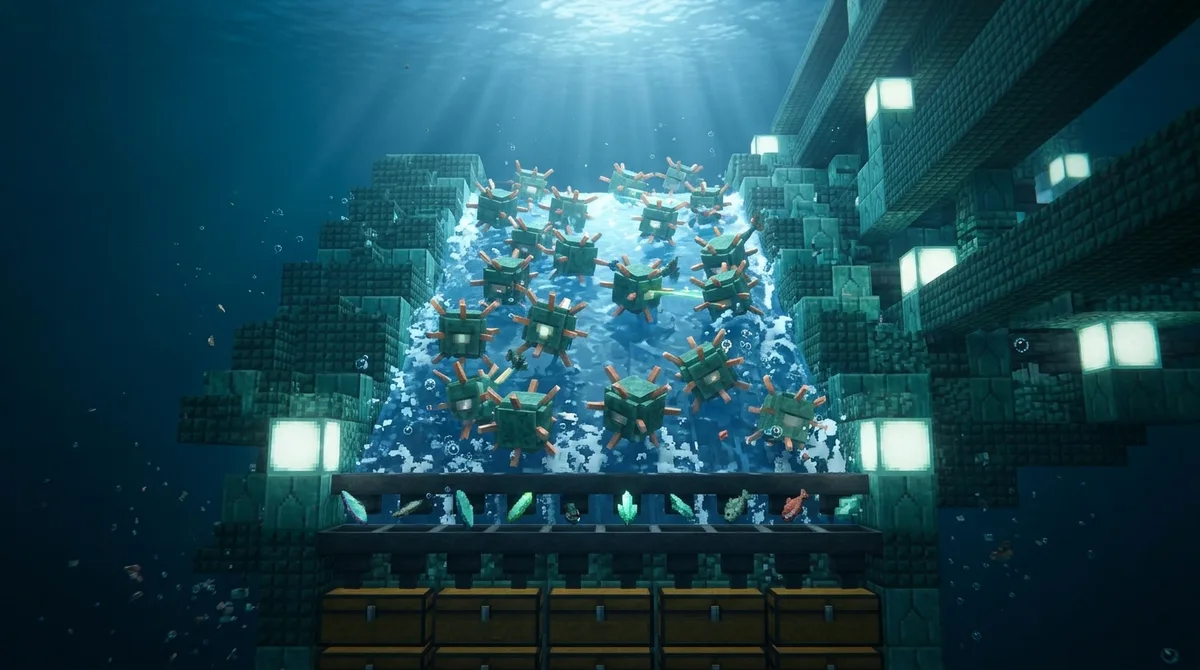
Guardians give you prismarine shards, prismarine crystals, and experience points, but only the experience depends on who makes the kill. In Java Edition, each guardian’s base loot can include 0 to 2 prismarine shards, with a 66.67% chance of at least one. Crystals are rarer, so you can expect them less often.
- Prismarine shards: 0 to 2 per guardian, with a 66.67% chance of at least one
- Prismarine crystals: 0 or 1 per guardian, with a 40% chance
- Experience: 10 XP per guardian killed by you or a tamed wolf
The experience rule shapes your whole farm. A guardian that dies from a fall, lava, or any other cause that isn’t you or a tamed wolf gives you no XP. That’s why your killing area needs to be a place where you, or a wolf you have tamed and brought along, can land the final blow.
Crystals and shards both matter for building. Sea lanterns need both, so a farm that gives you a steady supply of each lets you light up a monument-themed base without hunting through the ocean for them.
The 180,000 XP per hour figure comes from the Minecraft Wiki’s theoretical math. Experience orbs can be absorbed at a limit of 10 per second, and each orb averages 5 XP, which works out to 50 XP every second. Keep the orbs flowing for a full hour and you reach 180,000 XP. That number assumes a constant stream of kills and orbs, so treat it as a ceiling, not a rate your farm will hit on day one.
Does a Guardian Farm Work the Same in Java and Bedrock?
No, a guardian farm doesn’t work the same way in Java and Bedrock. The two editions decide where guardians can spawn in different ways, so their spawning rules differ substantially, and a design built for one can sit empty in the other.
In Java Edition, guardian spawning fails 95% of the time in open-sky water below sea level, which is Y=63 by default. That low success rate means your spawning pool needs to be large and open to the sky, so you get enough attempts to keep your killing room stocked. Place the pool below Y=63, and check your world’s sea level before you dig. If you’ve changed sea level in your world settings, the pool has to sit below the new line instead. Expect slow progress early on, and plan your waiting spot so you can keep an eye on the pool while it fills.
Bedrock Edition works differently. Guardians there spawn in water source blocks at 25 predetermined columns tied to the ocean monument, so your job is to find those columns rather than dig a new pool. Walk the monument’s water rooms and wings with the spawn columns in mind, then wall off the water around the ones you want to use. Keep the water as source blocks, not flowing water, because a guardian needs a source block to spawn in. Put your killing room right beside the chosen columns so you don’t have to swim far between the spawn point and the kill.
Pick one edition before you place any blocks, and write down its game version next to it. If you’re building in Java, design around the 95% failure rate and the Y=63 sea level. If you’re building in Bedrock, design around the 25 columns and the source-block rule. A layout that suits one edition won’t suit the other, so don’t borrow a plan from a video or guide without checking which edition it was made for.
Build a No-Drain Guardian Farm Step by Step
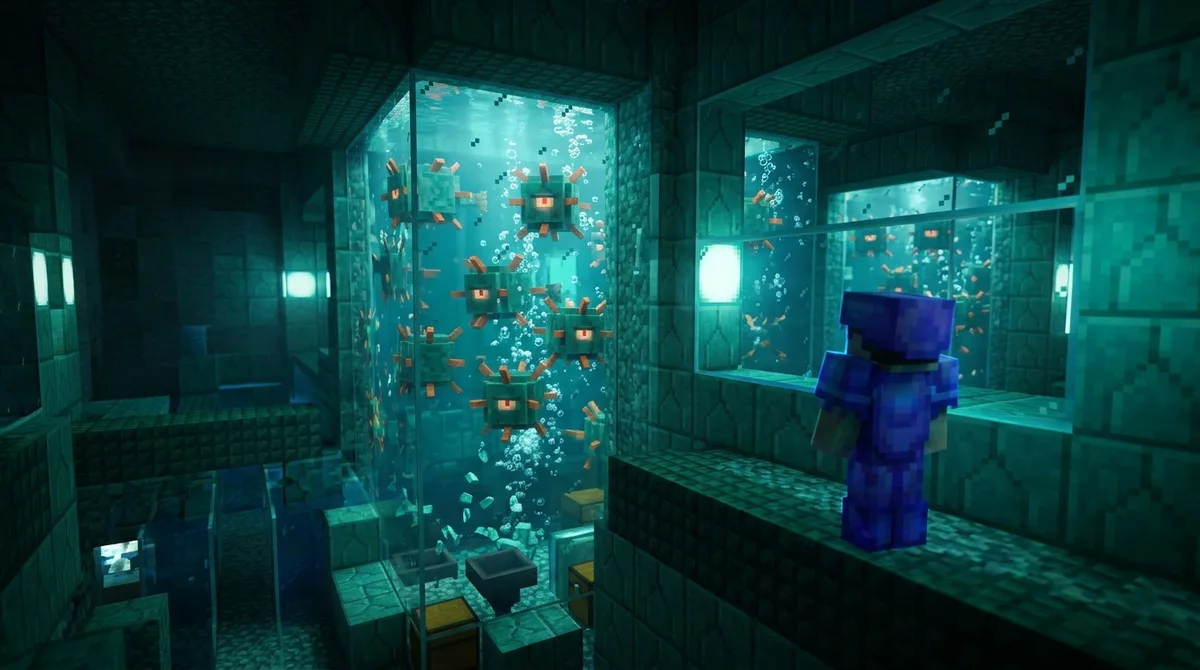
Some Java builds skip draining the monument entirely. Instead, they place soul sand on the monument floor under the water. Soul sand creates a bubble column that pushes water and any mob above it upward. The soul-sand section can be a small square if you only need a few guardians, or it can cover the monument’s full 56×56-block area if you want to move a large group at once. This design is for Java Edition, so write down your game version before you start.
Work through these steps in order, and keep each one in Java Edition.
- Pick a flooded room with a spawning pool that sits below sea level, at Y=63 or lower in the default world settings, and place your soul-sand section on the floor beneath it.
- Set the soul sand in a square and check that bubbles rise from its top surface before you move on.
- Build a dry kill chamber above the top of the bubble column, with an open ledge where guardians will rise within reach.
- Place a solid block one step back from the column’s top, and stand on it so you can strike each guardian as it is pushed up.
- Run a water channel from the far end of the kill chamber to a dead-end collection room, so drops float away from the fight.
- Put a hopper at the end of that channel, feeding a chest, so prismarine shards and crystals collect without you swimming to pick them up.
- Build a sealed waiting room beside the kill chamber, and separate the two with a glass wall so you can watch the column while you stay out of the guardian’s laser.
- Test the setup with a few guardians, and confirm that each kill you make gives you 10 XP.
Keep the waiting room sealed and the kill chamber open only where you need it. If a guardian dies from a fall or lava instead of your hit, it still drops loot but gives you no XP, so the stand-on block must be the spot where you land the final strike every time.
Why Is My Guardian Farm Not Working?
Most slow guardian farms come down to five things: spawn rules, water placement, bubble column transport, drop collection, and who lands the final hit. Check them in that order before you rebuild anything.
Start with the spawn rules. In Java Edition, spawning fails 95% of the time in open-sky water below Y=63, so a slow trickle of guardians early on is normal. Give the pool time, and only expand it if you’re still seeing almost nothing after a long wait.
Bedrock players should walk to each of the 25 spawn columns and confirm that the water there is made of source blocks. Flowing water or an air gap from a broken wall can stop a guardian from appearing in that column, so patch the gaps and check again.
For no-drain Java builds, stand over the soul sand and watch for bubbles rising to your kill chamber. If the bubbles stop short, look for a block sitting on the soul sand or a broken wall in the column’s path. If guardians get stuck against a ceiling or in a corner, open up the space above the column so they can rise freely.
Next, check collection. Drops that sit in the channel, or float past the hopper, are effectively lost. Make sure the hopper is directly under the channel’s end, that the chest feeding it has room, and that nothing blocks the path to the chest.
Finally, check the XP. A guardian killed by a fall or lava still drops loot, but it gives no XP. Stand on the block you chose for the kill every time, or bring a tamed wolf to finish the fight so the kill counts.
- Spawn pool: enough open-sky water below Y=63 in Java, or source blocks at the 25 columns in Bedrock
- Bubble column: bubbles reach the kill chamber with nothing blocking them
- Collection: the hopper and chest are in reach and have room
- Final hit: you or your tamed wolf land the kill
Are Guardian Farms Worth the Build Time?
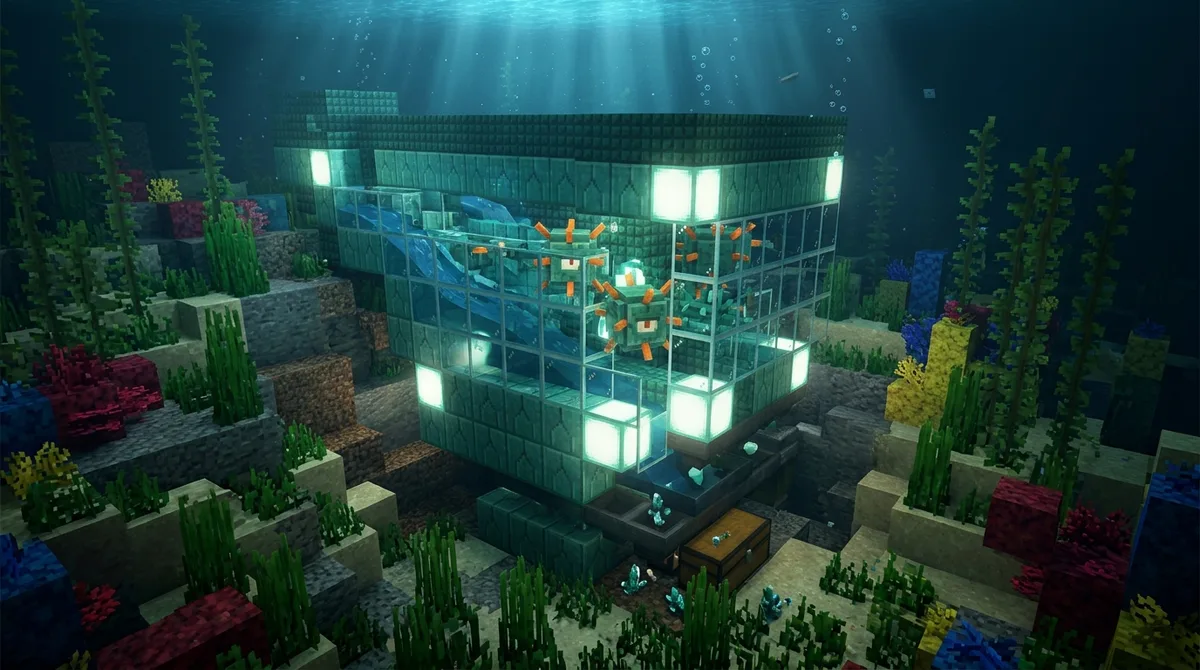
Yes, a guardian farm is worth the build time if you need prismarine for specific builds or a large amount of experience, and you don’t mind hands-on work. Guardian farms have no standard construction cost or build duration, so your time depends on three factors.
The first is how much monument space you can use. A no-drain Java design can run from a small soul-sand square to the full 56×56-block area. A bigger section moves more guardians at once, but it also takes more digging and more blocks. In Bedrock, the 25 spawn columns are already in place, so your time goes into walling off the water.
The second is how many spawns your design uses. Java spawning fails 95% of the time, so a small pool can leave you waiting in an empty room. A larger pool gives more attempts, at the cost of more building time.
The third is how much manual killing you need. Experience only counts when you or a tamed wolf makes the kill, so every guardian that needs your hit keeps you in the killing room.
Prismarine pays off in useful ways. Shards and crystals feed sea lanterns, and shards can be crafted into prismarine bricks and dark prismarine for monument-style walls and floors.
Experience depends entirely on how many guardians you kill. The 180,000 XP per hour figure is a theoretical ceiling, not a rate your farm will reach, so plan around the kills you can realistically make each session.
Start Your Own Guardian Farm Build Today
Start by confirming your edition and game version, because every later choice depends on them. Write both down where you can see them while you build. Next, pick an ocean monument you can reach safely, then walk its water rooms and wings to find a spot for your spawning area. Before you commit to the full layout, build a small test. In Java, wall off a short section of water below Y=63 and leave a dry ledge beside it. In Bedrock, check that the water at one spawn column is made of source blocks. Watch how many guardians appear over several play sessions. Once that small setup gives you steady spawns and kills, expand the pool or add the rest of the farm one piece at a time.
Pick Your Monument and Build Your First Guardian Farm
Start by writing down your edition and game version, then find the nearest ocean monument. Walk the outside first, then go inside and map its water rooms, wings, and the elder guardian rooms at the top and in each wing. Keep these notes handy, because they decide where your spawning pool can go.
Next, build a small test before the full farm. In Java Edition, pick a flooded room where the water sits below Y=63, wall it off, and leave one dry ledge beside it. In Bedrock Edition, go to one of the 25 spawn columns, confirm that its water is made of source blocks, and watch that column for several play sessions.
Count how many guardians appear each session and write the number down. Java spawning is slow, so a few quiet sessions don’t mean the design is broken. Every kill you make should give you 10 XP, so check that the XP orbs appear each time.
If the test spawns guardians steadily, widen the pool or add the soul-sand section one piece at a time. If nothing appears after a long wait, recheck the spawn rules for your edition before you add more blocks.
Stay out of the elder guardians’ range while you test. Their attacks can give you Mining Fatigue III, which slows your digging and makes a long fight much harder. Once your small setup works, you’ll know exactly which part of the monument is worth expanding.