
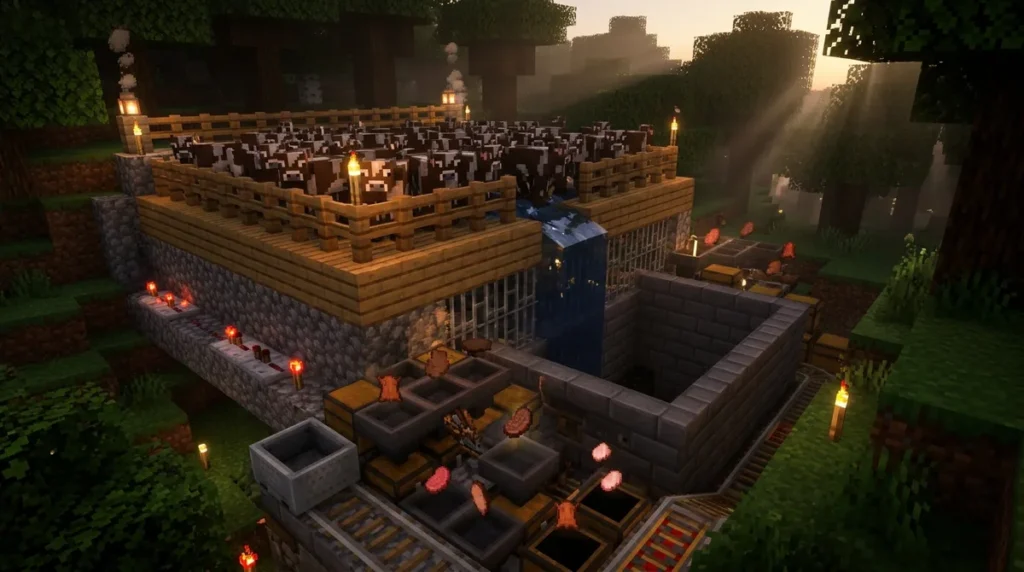
An automatic leather farm in Minecraft is a survival build that keeps cows breeding, growing, and dropping leather for you with very little hands-on work. Each adult cow drops 0 to 2 leather when killed, averaging 1 per kill, so a single cow won’t fill your inventory. The core loop is simple: you breed cows with wheat, let the calves grow up, and then collect the drops from the adults. Each breeding pair needs a short cooldown before it can breed again, so you’ll want several cows in the loop to keep your stock steady.
Calves take 20 minutes to mature, but each wheat you feed a baby cuts 10% off its remaining growth time, so you can speed up the pace. Baby cows drop nothing when killed, so the farm only pays off once they become adults. Add Looting III to your sword, and an adult can drop as many as 5 leather, which is a big boost over time.
Key Takeaways
- The 5-minute breeding cooldown caps how fast your farm grows, so add more breeding pairs instead of feeding cows extra wheat.
- Before placing any blocks, set a leather target and test one breeding pair to measure how much wheat your farm will use.
- A Bedrock cow farm build calls for a lava bucket, yet you must supply every bit of wheat yourself.
- Each book you craft uses exactly 1 leather, so your farm’s output sets how many books you can make.
How Does a Cow Leather Farm Work?
A cow leather farm works by breeding adult cows with wheat, raising their calves until they grow up, and then collecting leather from the adults. Wheat is the only thing you have to supply, because every breeding step in the loop depends on it. Keep a stocked chest of wheat close by so the farm never stalls.
To start a breeding pair, feed wheat to two adult cows. They enter love mode and produce a calf. Once a pair has bred, the cows need to wait out a breeding cooldown of 5 minutes before they can breed again. That timer is the main limit on how fast the farm can grow, and you can’t skip it by feeding the cows more wheat.
A single pair can only produce so many calves, so the farm needs several breeding pairs running at once. Think of your pens in stages. Some cows are in a cooldown, some are breeding, and some are adults waiting for collection. As long as each stage has cows in it, the flow of leather keeps going.
Calves are the bridge between the two ends of the loop. Because they take a long time to grow up, you need new calves coming in all the time. If you let your breeding pairs run out, you’ll soon have no adults left to drop leather.
It’s worth planning your numbers before you build. More pairs means more calves in the pipeline, which means more adults ready to drop leather down the line. Fewer pairs means a slower, steadier trickle. Either way, the cooldown sets the pace, so the size of your herd matters more than how fast you can click.
Why Do Baby Cows Need Time to Grow?
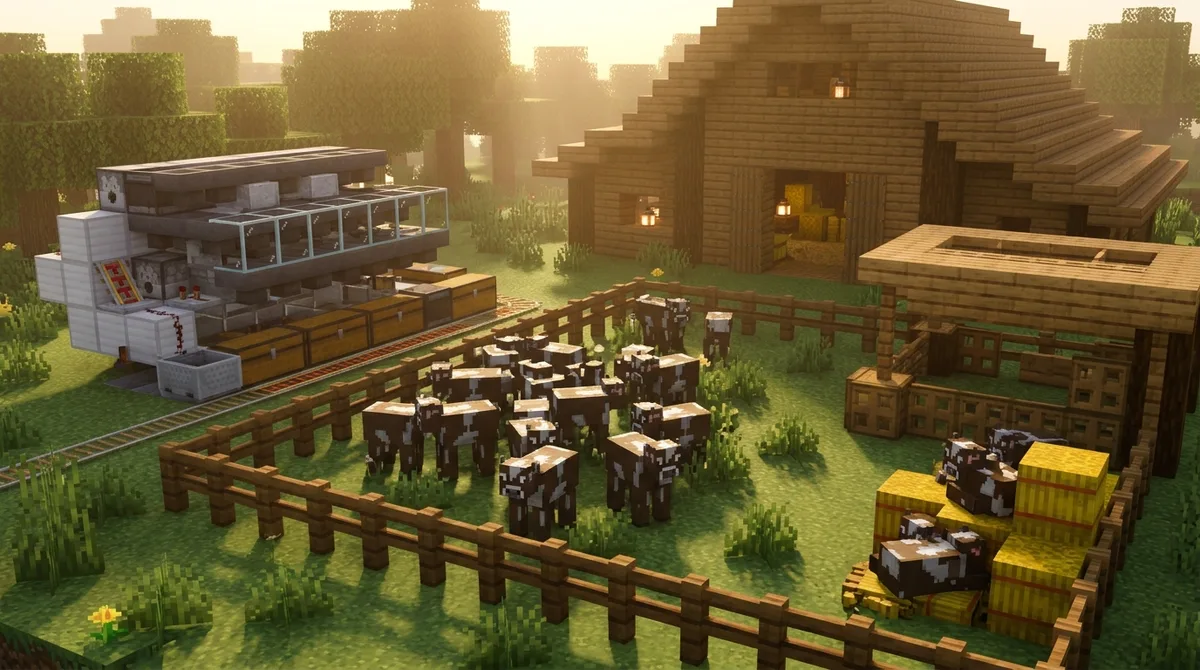
Baby cows need time to grow because a calf only becomes an adult, the kind of cow that drops leather, once its growth timer runs out. Until then, a calf is a dead end for your farm. Killing one gives you no items and no experience, so you’d just waste the wheat you spent on it.
That delay shapes how you plan the farm. Every calf in your pens is a future leather drop, but none of them will pay you back right away. If you only have a few calves coming in, you’ll wait a long time before the adults in your collection area start producing leather.
You can speed things up with wheat. Each wheat you feed a calf removes 10% of the growth time it has left, so the first bite takes 2 minutes off a 20-minute timer. Because the cut is based on what’s left, every extra wheat trims a little less than the one before it, so the early feedings do the most work.
This is where wheat planning matters. The same wheat you use to speed up calves is also what you need to breed the adults, so a farm that feeds every calf will burn through its supply faster than you might expect. Keep a stocked chest of wheat close to the calf pen, and top it up before you start a new breeding round.
It also helps to keep calves in their own pen, away from the adults you collect from. That way you won’t accidentally strike a baby while you’re gathering leather, and you can see at a glance how many calves are still growing and how many are ready to join the adult group.
How Much Leather Does Each Cow Drop?
An adult cow drops 0 to 2 leather when you kill it, averaging 1 leather per kill. The amount is random, so one cow might give you nothing while the next gives you two. About two out of three kills drop at least one leather, which means roughly one kill in three comes back empty.
That randomness means you should plan for a few extra cows. If you want 10 leather with a plain sword, expect to need about 10 adult kills on average, and possibly a few more to be safe.
Looting III changes that math. With the enchantment on your sword, an adult cow can drop up to 5 leather and averages 2.5 per kill. The same 10 leather now takes about four adult kills instead of ten, which makes a big difference when every adult has to be bred and raised first.
To size your herd, start with your target. Here is a quick guide for common goals:
- Default sword: about 1 adult kill per leather, so 8 adults for 8 leather.
- Looting III sword: about 1 adult kill for every 2.5 leather, so 4 adults for 10 leather.
- Buffer: add a few extra adults on top of the average to cover empty kills.
Remember that each adult you harvest has to be raised from a calf first. If your adult group is small, the breeding pairs in your pens will need time to replace them, so keep the pipeline full before you start cutting your numbers close.
What Parts Do You Need for a Bedrock Cow Farm?
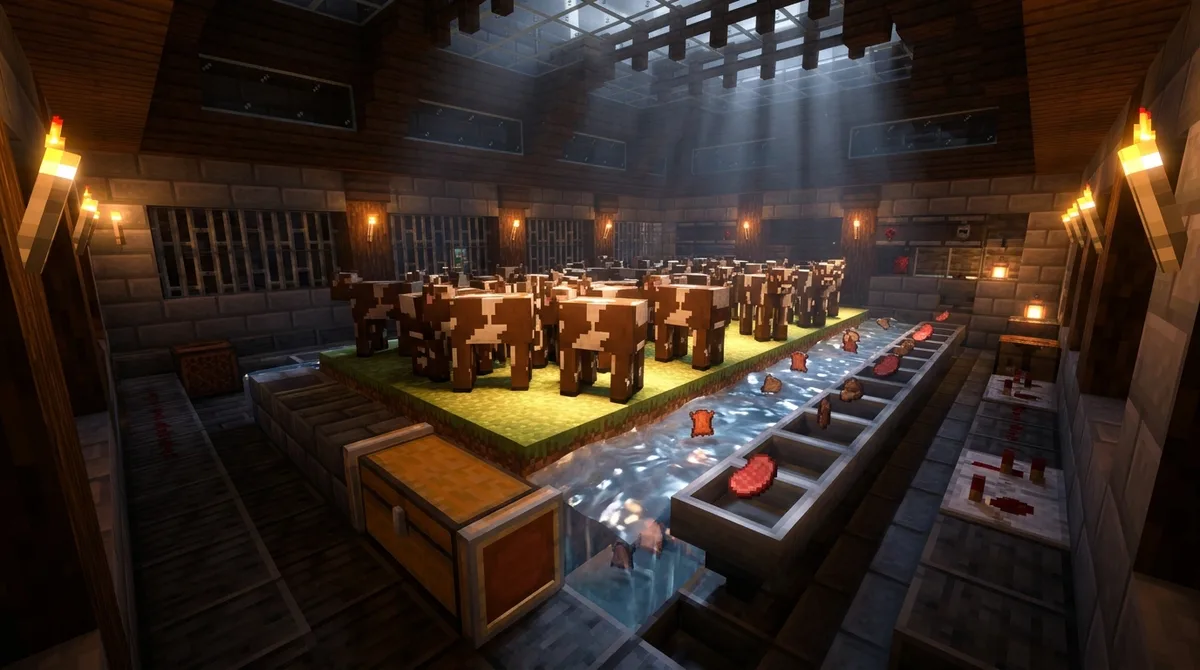
One current Bedrock design lists an estimated inventory of 2 chests, 2 hoppers, 3 dispensers, 2 water buckets, 1 lava bucket, and 2 starter cows. That’s a short shopping list for a farm that can keep your leather stocked for a long time. Our build guides name every block and item, so you’ll know exactly what each piece does.
- 2 chests
- 2 hoppers
- 3 dispensers
- 2 water buckets
- 1 lava bucket
- 2 starter cows
The lava bucket goes into a dispenser as part of the build, so it has a fixed place in the design rather than being an optional extra. Keep that lava dispenser on its own so it’s easy to find when you’re troubleshooting.
The other dispensers are for water. Water dispensers send streams across the farm floor, and those streams carry the drops toward the hoppers. Hoppers catch the items and pass them along into the chests, which is where your leather ends up. So the water dispensers, hoppers, and chests handle the day-to-day operation and collection.
Notice what’s missing from that list: wheat. The build doesn’t make it for you, so you’ll need to supply every bit of it. You’ll feed it to your cows to start breeding, to speed up calves, and to keep the loop moving. Keep a stocked chest of wheat near the pens so you don’t have to run back to your fields mid-cycle.
You also run the farm yourself. Someone has to start the breeding pairs, move calves into the right pen, switch the dispensers on when it’s time to collect, and empty the chests before they fill up. The build does the sorting and the catching, but it won’t feed or tend your cows for you.
Java and Bedrock Versions and Cow Variants
Java and Bedrock both support this farm, and the core loop works the same way on either edition. You breed adult cows with wheat, raise the calves, and collect leather from the adults. Where a step behaves differently between the two editions, we’ll point it out.
Cow variants came with Minecraft Java Edition 1.21.5, released on March 25, 2025, as part of the Spring to Life update. That version added cold and warm cow variants to the game.
Do warm and cold cows change your farm? No. They’re a visual variant, so they look different in your pens but follow the same breeding, growing, and drop rules as the standard cow. Your breeding pairs, calf pen, and collection area can stay exactly as you built them.
Here’s what that looks like in practice. Say you have a warm cow pen on Java 1.21.5. You feed wheat to two warm adults, and they produce a calf. That calf still needs 20 minutes to mature unless you speed it up with wheat, and once it becomes an adult, you collect its leather in the same spot as any other cow.
Bedrock Edition runs on its own release schedule, so the variant you see in one edition may not match the other. Check your game version before you start a build. Our guides name the version a feature needs, so you won’t end up planning around a cow type your game doesn’t have yet.
Using Leather for Books and Item Frames
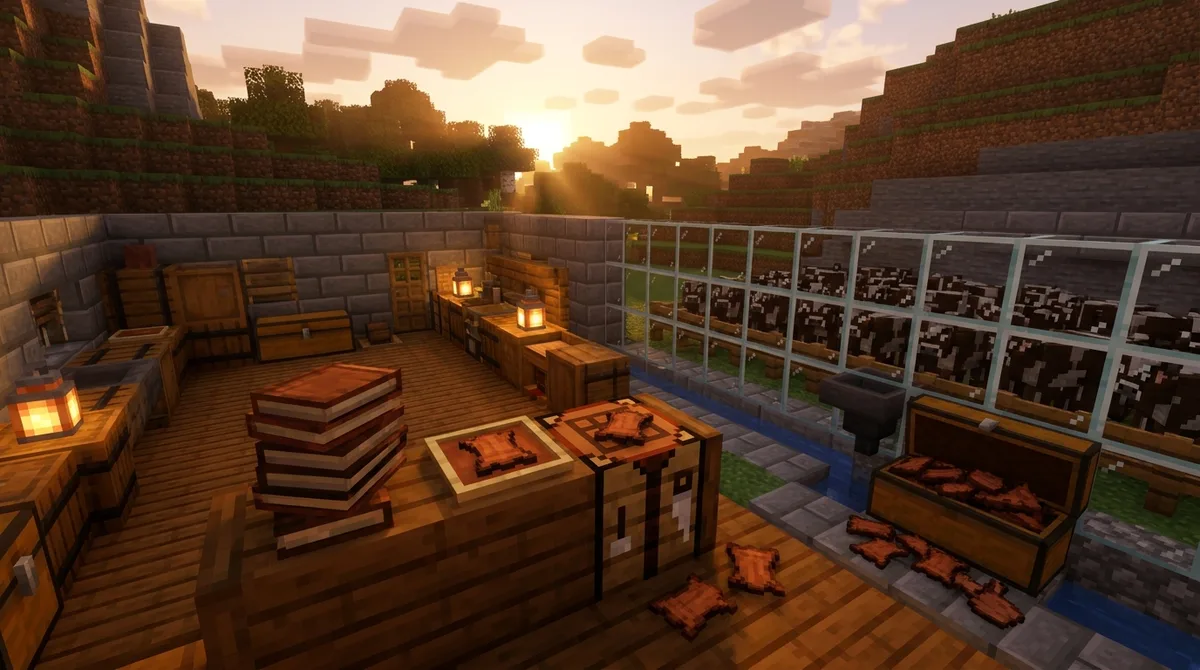
Leather goes into two recipes that survival players use constantly, and both are easy to plan around. A book recipe uses 1 leather and 3 paper to make 1 book, so every book you craft costs exactly one leather from your farm.
Item frames are the other big use. Each item frame takes 1 leather and 8 sticks, according to the item frame page on the Minecraft Wiki. The leather cost is small, but the sticks add up quickly, so have a stocked supply of wood and sticks ready before you start.
Start with your leather goal, then count the other ingredients to match. Here are a few examples:
– 10 books: 10 leather and 30 paper – 6 item frames: 6 leather and 48 sticks – 4 books and 4 item frames: 8 leather, 12 paper, and 32 sticks
Notice that the paper and sticks come from your inventory, not your cows. Your farm only supplies the leather, so you can plan your breeding pairs around the number of books or frames you want to craft each week. Keep your leather chest sorted so you always know how much you have on hand.
Planning Your First Leather Supply
Start with a number. Decide how much leather you want by the end of your first play session, such as 10 leather for a few books. Then work backward to the adult cows you need. With a plain sword, 10 leather takes about 10 adult kills on average. With Looting III, it takes about four. Write that target down before you place a single block.
Next, set up one breeding pair and watch it closely. Feed wheat to two adult cows, wait for the calf, and note how long it takes to grow up. Then try a second calf with a few wheat feedings and compare the two. This small test tells you how much wheat your full farm will burn through each day.
Once you know your pace, plan the calf pen and the collection area so they stay separate. Keep one chest of wheat beside the calf pen and another chest ready for your leather. A short walk between those spots saves a lot of time when the farm gets busy.
Finally, craft one book as soon as you have your first leather. It uses 1 leather and 3 paper, so it’s a quick way to confirm your farm is delivering what you expected. If the numbers match your target, add more breeding pairs. If they fall short, add a few extra adults to cover the empty kills.